Fulbright Visiting Scholar Program: Applications Open for Bangladeshi Professionals
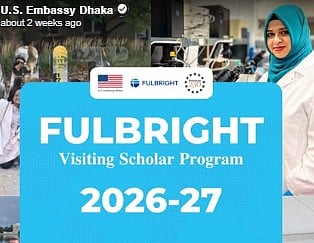
Applications are now being accepted for the Fulbright Visiting Scholar Program, which offers grants for research and teaching at U.S. institutions for one academic year. This program is open to experienced Bangladeshi public and private sector professionals, university teachers, and researchers with at least 10 years of experience. Over the past 52 years, more than 200 Bangladeshis have participated in this exchange. Notable alumni include Nobel laureate Professor Muhammad Yunus. The current application cycle is for the 2026-27 academic year, with the program set to commence in September 2027. The program aims to support scholars with advanced degrees (PhD or equivalent) who propose innovative research and teaching projects in their specialized fields. Applicants must demonstrate English language proficiency. Priority is given to proposals related to university administration, curriculum development, distance learning, educational technology, public health, biology, pharmacy, climate change and disaster management, urban planning, and international relations. Short-term grants are also available for educators interested in needs assessment, curriculum development, and evaluation. Benefits for selected scholars include round-trip airfare, tuition and academic fees, a monthly stipend for living expenses, book allowance, health and accident insurance, and travel allowances. The application deadline is October 3, 2026, at 10:59 AM Bangladesh time. Further details and the online application form can be found via the provided links, or by contacting [email protected].
The Fulbright Visiting Scholar Program exemplifies a long-standing U.S. foreign policy initiative aimed at fostering mutual understanding and academic exchange. By offering full funding, the program significantly lowers barriers to participation for international scholars, particularly those from developing nations like Bangladesh. This strategic investment in human capital can yield substantial long-term benefits, including the cultivation of future leaders and the establishment of robust international research collaborations. The program's focus on specific, contemporary fields like climate change and educational technology suggests an alignment with current global challenges and technological advancements. Evaluating the program's impact over decades, it's evident that such initiatives contribute to soft power and global scientific progress, though their effectiveness hinges on sustained commitment and adaptation to evolving geopolitical and technological landscapes.
AI-generated to prompt reflection — not editorial opinion, not advice, not a statement of fact. How this works.