Government to Decide on Former President at Appropriate Time, Says Law Minister
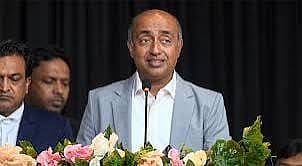
Bangladesh's Law Minister, Anisul Huq, stated that the government will make a decision regarding the recently resigned President, Mohammed Shahabuddin, after thorough verification and at the appropriate time. He made these remarks on Sunday afternoon to journalists in Chittagong, following an event hosted by the Chittagong District Bar Association. Responding to questions about demands from various political parties for action against the former president, the minister assured that the government would consider public demands while ensuring no one is unjustly victimized. He emphasized trust in the Prime Minister and the cabinet to make the right decision at the right moment. Regarding the timeline for electing a new president, the minister cited Article 123(2) of the constitution, which mandates an election within 90 days of a vacancy. He deferred questions about any travel restrictions or legal impediments for the former president's medical treatment abroad to the Ministry of Home Affairs, citing confidentiality and national security. Several political parties, including the Jatiya Nagarik Party, Bangladesh Khelafat Majlis, and Inkilab Mancha, have called for the arrested and trial of the former president. The minister acknowledged these demands, stating they would be legally examined for their validity. President Shahabuddin resigned on Friday, citing health reasons, with Parliament Speaker Hafizuddin Ahmad assuming the role of Acting President. The Law Minister also addressed issues of false cases, noting the recent amendment to Section 173(A) of the Criminal Procedure Code, and urged citizens to report any instances of police-initiated cases, extrajudicial killings, or enforced disappearances. Earlier, he was the chief guest at the inauguration of a five-day training workshop for 1,100 new lawyers organized by the Chittagong District Bar Association. He also highlighted that approximately $234 billion USD has been illegally siphoned out of Bangladesh through documented channels over the last 16 years, citing a report from Time magazine, and that significant amounts of money were looted from development projects during previous governments.
The government's measured approach to addressing demands for action against the former president, emphasizing due process and thorough verification, reflects a strategy to balance public sentiment with legal and constitutional frameworks. This stance aims to avoid precipitous actions that could lead to legal challenges or political instability, while also acknowledging the public's desire for accountability. The minister's broader comments on corruption and illicit financial outflows underscore systemic challenges within the nation's economic and governance structures. The government's stated commitment to investigating these issues, alongside the specific case of the former president, suggests an intent to address both individual allegations and broader institutional weaknesses. Moving forward, the efficacy of these efforts will depend on transparent investigations, adherence to legal due process, and the government's ability to demonstrate tangible progress in curbing corruption and financial crime, thereby reinforcing public trust in its institutions.
AI-generated to prompt reflection — not editorial opinion, not advice, not a statement of fact. How this works.