Government Will Not Tolerate Extremism, PM Assures Parliament
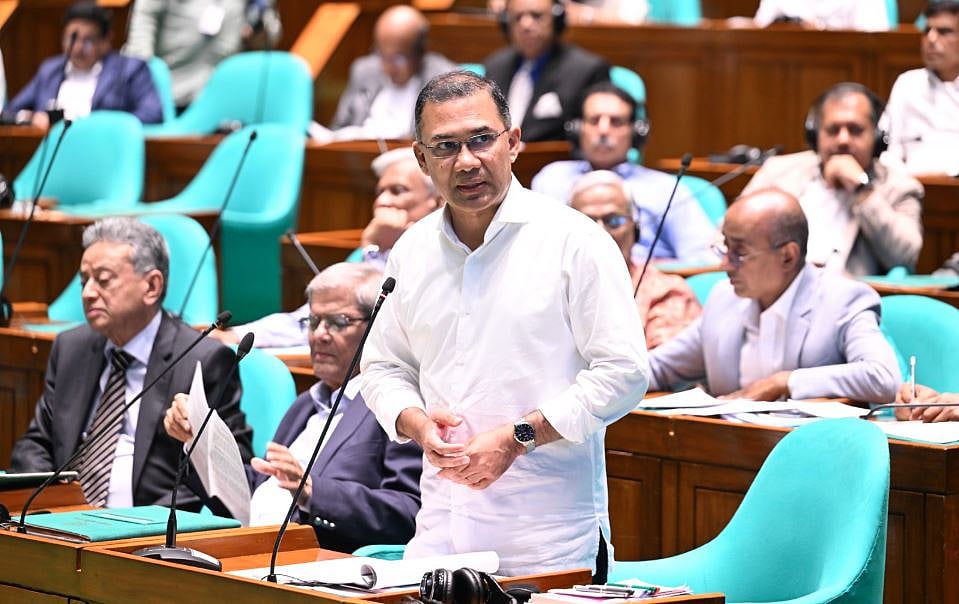
Prime Minister Tareq Rahman stated in Parliament that the current government will not tolerate any form of extremism or radicalism. He expressed confidence in receiving full cooperation from the opposition on this matter. The Prime Minister also hoped that national unity would remain strong to prevent fascism and subservience from taking root in the country. These remarks were made during the closing session of the 13th National Parliament's budget session, which concluded today after 26 working days. The session saw the passage of 10 bills, with numerous questions submitted and answered for both the Prime Minister and various ministers. Several parliamentary committees were also formed.
In his address, Prime Minister Rahman outlined plans for a discrimination-free and accountable welfare state, including social safety net programs and a shift from a loan-dependent to an investment-driven economy to create jobs. He emphasized that no one would be allowed to undermine democratic rights in the name of liberation war ideals and expressed concern over the decline of religious, social, cultural, and family values, calling for a revival of family values. He also stressed that while disagreements with the opposition are natural, they should not lead to enmity, advocating for justice over revenge.
The Prime Minister highlighted the commitment to national unity to prevent the resurgence of fascism and ensure the country does not become a subservient state. He referenced the July Accord, stating that all parties are committed to its implementation. He criticized past regimes for focusing on development narratives without tangible results, alleging that the electricity sector was exploited for personal gain. The Prime Minister acknowledged the current economic challenges due to global conflict but expressed optimism about recovery through public cooperation and planned initiatives, aiming for a trillion-dollar economy by 2034. He reiterated that combating corruption and ensuring law and order are top priorities, noting that $16 billion USD was allegedly siphoned out annually during the previous regime. The government aims to professionalize law enforcement and restore the health sector, which he claimed was deliberately destroyed to benefit a specific country under the previous fascist government. He also pledged to increase education sector allocation to 5% of GDP within five years, aiming to reverse the alleged destruction of the education system and promotion of cheating during past autocratic rule.
The Prime Minister's address underscores a commitment to national unity and a rejection of extremism, framing these as essential for preventing a return to past authoritarianism and subservience. The narrative emphasizes a transition towards an investment-driven economy and social welfare, contrasting sharply with alleged past corruption and mismanagement, particularly in the health and education sectors. This framing positions the current government as a bulwark against historical injustices and external influence, aiming to foster a stable and prosperous nation. The analysis of past economic policies and governance structures suggests a focus on systemic reforms to ensure accountability and equitable development, aligning with a vision for a stronger, independent Bangladesh. The emphasis on national unity and shared commitment to specific accords indicates a strategy to consolidate political capital and address complex socio-economic challenges through broad-based support, while simultaneously drawing a clear distinction from previous regimes perceived as corrupt and detrimental to national interests.
AI-generated to prompt reflection — not editorial opinion, not advice, not a statement of fact. How this works.