Greece Battles Multiple Wildfires Amidst Strong Winds; Tourists Evacuated
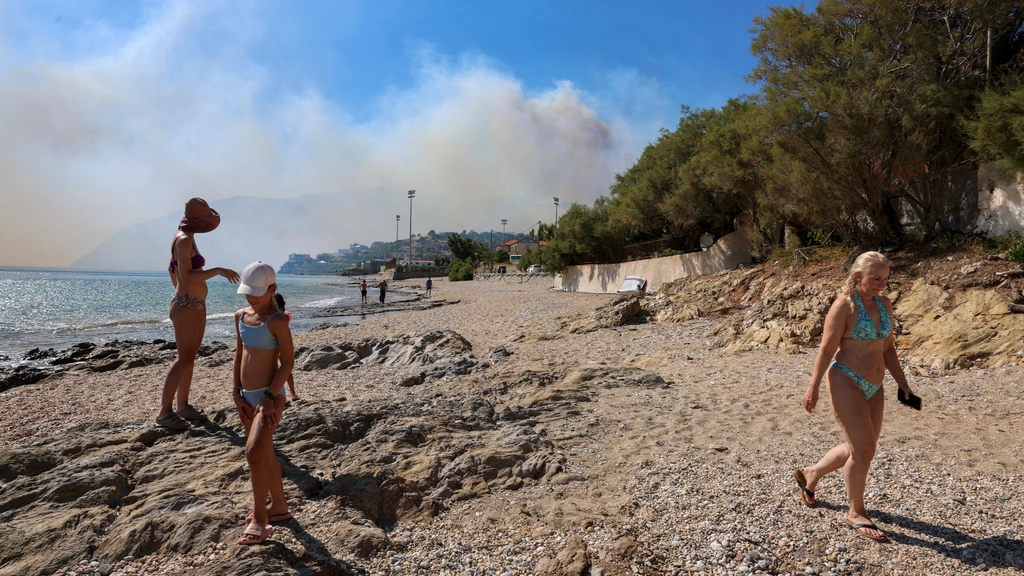
Greece is currently grappling with multiple uncontrolled wildfires across several islands, including Paros, Andros, Lesbos, and Crete. Extremely strong gusts of wind, exceeding 125 kilometers per hour, are severely hampering firefighting efforts, particularly the use of aerial resources. Forecasters anticipate the wind will not subside until the weekend, leading Greek Prime Minister Mitsotakis to warn of "difficult days ahead." On Lesbos, at least 100 hectares of land, including pine forests and olive groves, have been destroyed. Firefighters are still battling smoldering embers in dry undergrowth, posing a risk of reignition. Over 8,000 people, many of whom were tourists, were evacuated from the vicinity of Agia Galini on Crete's south coast overnight and were temporarily housed in a shelter before being allowed to return on the following day. Another critical wildfire is raging in the Rethymno municipality on Crete, described as the most severe in Greece, with fire crews fighting a large blaze that is rapidly spreading due to powerful winds. Dutch travel organization Sunweb evacuated over 250 travelers from Crete as a precautionary measure, relocating them to alternative accommodations and arranging transportation. Corendon also moved dozens of travelers to different hotels, while TUI reported no accommodations near active fires. Tragically, three firefighters lost their lives while battling the blazes: one on the Peloponnese peninsula and two on Crete, after being trapped by the flames. Authorities attribute Greece's relative lack of large-scale fires earlier in the summer to a lack of prolonged heatwaves and improved prevention measures, including drones and satellites. However, the current fires on Crete demonstrate that even advanced technology and additional resources are insufficient against hurricane-force winds. Meanwhile, Turkey is also contending with wildfires in its southern and western regions, particularly in Antalya, Mugla, and Balikesir provinces, also exacerbated by strong winds.
The current wildfire situation in Greece, exacerbated by extreme wind conditions, highlights the persistent vulnerability of Mediterranean regions to climate-driven natural disasters. While Greece has implemented advanced technological prevention measures, such as drones and satellites, the events underscore that even sophisticated systems have limitations when confronted with severe meteorological phenomena. The loss of life among firefighters is a tragic reminder of the inherent risks faced by first responders. The situation also presents challenges for the tourism-dependent Greek economy, necessitating swift and effective evacuation and support for affected travelers. Looking ahead, the increasing frequency and intensity of such events globally suggest a need for continuous adaptation of firefighting strategies, urban planning in fire-prone areas, and a broader societal focus on climate change mitigation to reduce the likelihood and impact of future infernos.
AI-generated to prompt reflection — not editorial opinion, not advice, not a statement of fact. How this works.