Greece's Strategic Pivot: Deepening Ties with Gulf States Amidst Shifting Alliances
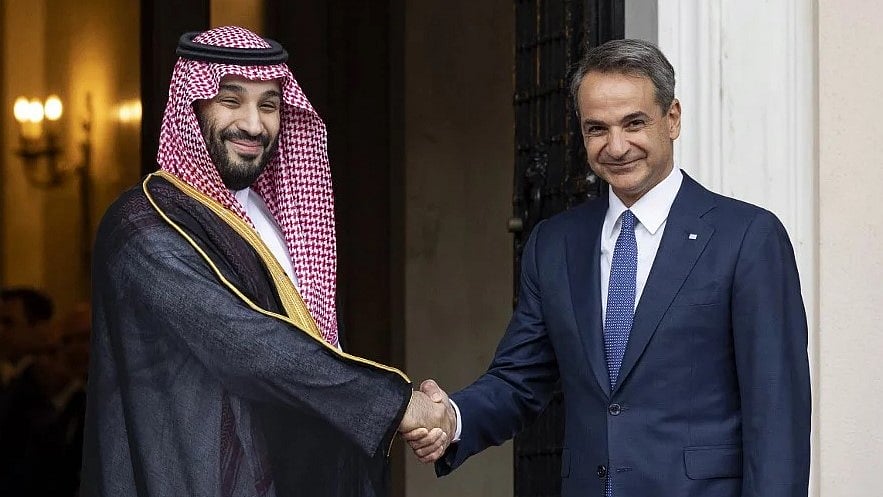
Greece has significantly deepened its relations with Gulf countries since late 2019, a development that initially appeared to be a straightforward economic partnership. However, a closer examination reveals a more complex geopolitical strategy, characterized by two distinct phases, both aligning with an escalating alliance with Israel and a deteriorating relationship with Turkey. The first phase, from roughly 2016 to 2021, focused on forming an anti-Turkey bloc centered around Greece, Israel, and Cyprus, with attempts to include France, Egypt, Khalifa Haftar's Libya, Bashar al-Assad's Syria, and the UAE and Saudi Arabia during the 2017 Qatar blockade. While economic and energy cooperation were publicly emphasized, the core of this alliance was security and defense, facilitated by Abu Dhabi and Riyadh's informal alignment with Israel's regional policies.
This period saw Greece sign strategic agreements with several Gulf Cooperation Council (GCC) members. In November 2020, Greece and the UAE signed a strategic partnership and a separate foreign policy and defense agreement, pledging mutual support if either nation's sovereignty was threatened. The UAE also deployed military forces to Greece for joint exercises, strengthening coordination within a broader security network involving Greece, Cyprus, Egypt, France, and Israel. Greece's security policy became deeply integrated with Israel's, a unique development in Europe, particularly as Israel faced international isolation and potential arrest warrants for alleged war crimes. Similarly, a 2021 defense pact with Saudi Arabia led to Greece deploying a Patriot missile defense battery and personnel to the Kingdom, alongside joint military exercises and high-level visits.
The anti-Turkey bloc's foundation eroded with the resolution of the 2017 Gulf crisis and the normalization of relations between Turkey and the UAE, Egypt, and Saudi Arabia, rendering Greece and Israel's strategy to use GCC states against Ankara largely obsolete. Consequently, Greece entered a second phase from 2023 to 2026, re-engaging with GCC states. This phase also mirrored the two key trends: a closer alliance with Israel and increasing tensions with Turkey. Greece aimed to expand the influence of the Greece-Israel defense and security cooperation into the Gulf and to counter Turkey's growing role in Saudi Arabia, the UAE, and Qatar.
This renewed push involves Greece integrating its security policy with Israel to an unprecedented degree, even as Israel faces international scrutiny. Greece's 'Achilles Shield' air defense program, a $3.5 billion project integrating Israeli defense systems, and a recent $750 million allocation for Israeli precision rockets deployed near the Turkish border highlight this deep military integration. Israeli firms are training Greek pilots, and the acquisition of Intracom Defense by Israel's IAI signifies local production and technology transfer. This level of military cooperation suggests an institutional fusion rather than mere partnership, effectively supporting Israel's regional agenda amidst its diplomatic isolation. The strategy also seeks to counter Turkey's growing regional influence, as GCC states increasingly view Turkey as a strategic partner rather than a rival, especially with Turkey's initiative to build a regional security framework. This has led to Greece actively confronting Ankara's influence across various regions where Turkey is active, reinforcing its alliance with Israel. This dynamic is further exemplified by Israeli Prime Minister Netanyahu's proposal of a six-party alliance including Greece, Cyprus, and India, aimed at countering a new alignment forming around Saudi Arabia, Turkey, Pakistan, and Egypt. The Greece-Israel-Cyprus summit in December 2023 pledged deeper defense cooperation, including a planned 2,500-member joint rapid response force, explicitly presented as a deterrent against Turkey in the Eastern Mediterranean. Greece is also prioritizing energy, infrastructure, and connectivity projects with Saudi Arabia and the UAE, such as the India-Middle East-Europe Economic Corridor (IMEC), which notably excludes Turkey and Egypt, further aligning GCC nations with the proposed Israeli-led bloc. During the recent US-Israel-Iran conflict, Greece offered defense and security cooperation to GCC states, with its military facilities serving as crucial logistical hubs for responses to Iranian missile attacks in the Gulf.
This analysis examines Greece's strategic realignment with Gulf states, particularly its deepening security and defense ties with Israel. The narrative suggests a calculated geopolitical maneuver by Greece, leveraging its relationship with Israel to counter Turkey's regional influence and enhance its own standing within the Gulf. The framing highlights a potential system-level contradiction: Greece's pursuit of security through an alliance with a nation facing significant international legal and diplomatic challenges could expose it to reputational and strategic risks. Furthermore, the emphasis on excluding Turkey from key economic corridors like the IMEC indicates a zero-sum approach to regional stability, potentially fostering greater polarization rather than cooperation. The analysis prompts consideration of whether this strategy, driven by perceived immediate threats and geopolitical rivalries, aligns with long-term regional stability and economic integration goals, especially in an era where collaborative frameworks are increasingly vital for addressing complex global challenges.
AI-generated to prompt reflection — not editorial opinion, not advice, not a statement of fact. How this works.