Greek Education Reform Sparks Division Within Left-Wing Parties
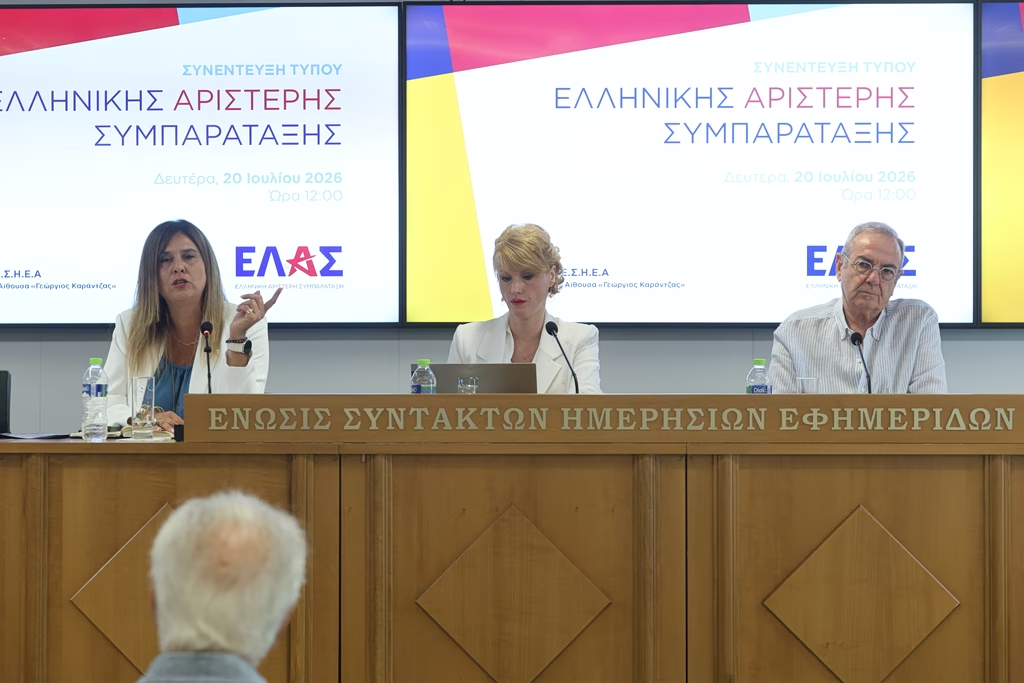
The recent presentation of five plus one proposals for education by Alexis Tsipras's Hellenic Police (ELAS) has ignited sharp reactions and divisions within the Greek left-wing political spectrum. Both SYRIZA and the New Left party have issued strong statements in response to the proposals. Ioanna Laliotou, the relevant sector minister, specifically addressed the establishment of University Legal Entities, which were created under the "Pierrakis law." She expressed concerns and criticisms regarding these entities, suggesting they are a point of contention. The debate centers on Article 16 of the constitution and the potential establishment of non-state universities, issues that are clearly polarizing the political landscape. The proposals presented by ELAS aim to address perceived shortcomings and future directions for the Greek education system. However, their reception highlights deep-seated ideological differences regarding university autonomy and public versus private higher education. The differing stances suggest a significant challenge in forging a unified educational policy for the left.
The debate over non-state universities and constitutional article 16 in Greece reflects a fundamental tension between market-oriented reforms and traditional public service models in higher education. The differing responses from SYRIZA and the New Left indicate a divergence in their strategic approaches to educational policy, potentially impacting their ability to present a cohesive political platform. As Greece navigates its economic recovery and seeks to modernize its institutions, the path chosen for higher education will have long-term implications for social mobility, research capacity, and international competitiveness. The underlying issue is how to balance access, quality, and financial sustainability in a rapidly evolving global landscape, particularly in the context of increasing technological integration and the demand for specialized skills.
AI-generated to prompt reflection — not editorial opinion, not advice, not a statement of fact. How this works.