Gulf Strategic Landscape Transformed by US-Iran Conflict, Future Uncertain
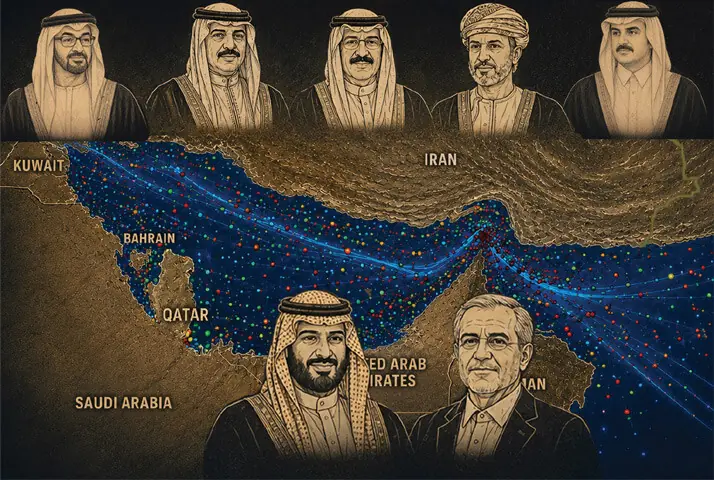
A recent Memorandum of Understanding (MoU) has partially halted the "United States-Zionist war of aggression on Iran," according to the analysis. This conflict significantly impacted global oil, gas, and agricultural markets, threatening food security and causing price hikes, prompting warnings of catastrophe from the UN Food and Agriculture Organization. The war was also domestically unpopular in the US, with President Trump reportedly seeking a deal to avoid blame for a global recession and to mitigate negative impacts on his party's prospects in upcoming elections. Iran, enduring the conflict's costs, was prepared to wait for the US to concede, which it ultimately did. The conflict has irrevocably altered the Gulf's strategic landscape, collapsing the old security paradigm and making a return to the pre-war status quo unlikely. While the MoU addresses immediate pressures, it does not resolve the underlying, decades-long structural issues between Iran and the US, nor the broader Israeli-Palestinian conflict. The analysis posits that the Gulf is now divided into a pre-war and post-war era, with the US likely to maintain its role as a net security provider. The Zionist regime is expected to continue its approach of perpetual conflict, while Gulf Cooperation Council (GCC) states face difficult choices regarding their relationship with Iran and the US. The GCC's historical internal frictions, stemming from rivalries between Saudi Arabia and smaller states like Qatar and Oman, and differing threat perceptions regarding Iran, have hampered its ability to form a cohesive security architecture. The UAE's evolving relationship with Iran and its entanglement with the Zionist regime, alongside its independent regional ambitions, have further complicated intra-GCC dynamics.
The recent cessation of hostilities between the US and Iran, facilitated by an MoU, marks a significant shift in the Gulf's geopolitical dynamics. The conflict's economic repercussions, particularly on global food and energy security, underscore the interconnectedness of international stability and regional conflicts. The US's decision to de-escalate, influenced by domestic political considerations and the economic costs of prolonged conflict, highlights the complex interplay between foreign policy objectives and electoral cycles. The analysis suggests that the traditional security architecture in the Gulf, heavily reliant on US guarantees and characterized by intra-GCC rivalries, is no longer tenable. The GCC's persistent institutional weaknesses and divergent national interests present a substantial hurdle to establishing a new, inclusive regional security framework. Future regional stability will likely depend on the GCC states' ability to navigate their relationships with both the US and Iran, potentially through a more nuanced approach that balances security imperatives with economic cooperation, while also addressing the unresolved Palestinian issue as a foundational element of broader Middle Eastern peace.
AI-generated to prompt reflection — not editorial opinion, not advice, not a statement of fact. How this works.