Homer and the 'Cancel Culture' Debate
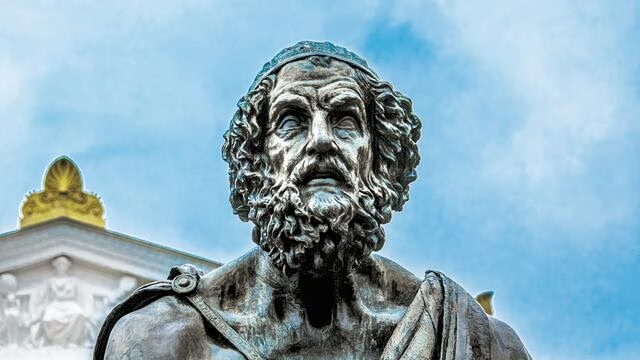
The question of whether Homer is 'in danger' is reframed, suggesting that as a literary figure, Homer has always been and remains present. American literary critic Harold Bloom, in 1975, stated that all literate individuals in the Western world, regardless of race, gender, or ideology, are still considered 'sons' of Homer. This observation implies a continuous and enduring influence of Homeric literature. The original text implies that the concept of 'cancel culture' might be anachronistic when applied to a figure like Homer, whose impact transcends specific historical or social contexts. The enduring presence of Homeric narratives and themes in Western literature suggests a resilience that resists such contemporary critical frameworks. Therefore, the discussion should perhaps focus on how Homer's works continue to be interpreted and relevant rather than whether his legacy is under threat.
The framing of Homer within a 'cancel culture' debate highlights a contemporary tendency to project modern social and political frameworks onto historical figures and canonical works. This approach risks anachronism, potentially overlooking the enduring and adaptive nature of classical literature. The enduring presence of Homeric epics suggests their capacity to resonate across diverse audiences and eras, independent of specific cultural or ideological shifts. The analysis should consider the systemic mechanisms that have preserved and promoted Homeric texts throughout history, such as educational institutions and literary traditions, and how these might interact with or be challenged by contemporary critical lenses. This perspective encourages a nuanced understanding of cultural transmission and the evolving reception of foundational texts.
AI-generated to prompt reflection — not editorial opinion, not advice, not a statement of fact. How this works.