Huawei's Tao's Law V2 Paper Details Logic Folding for Faster Kirin CPUs
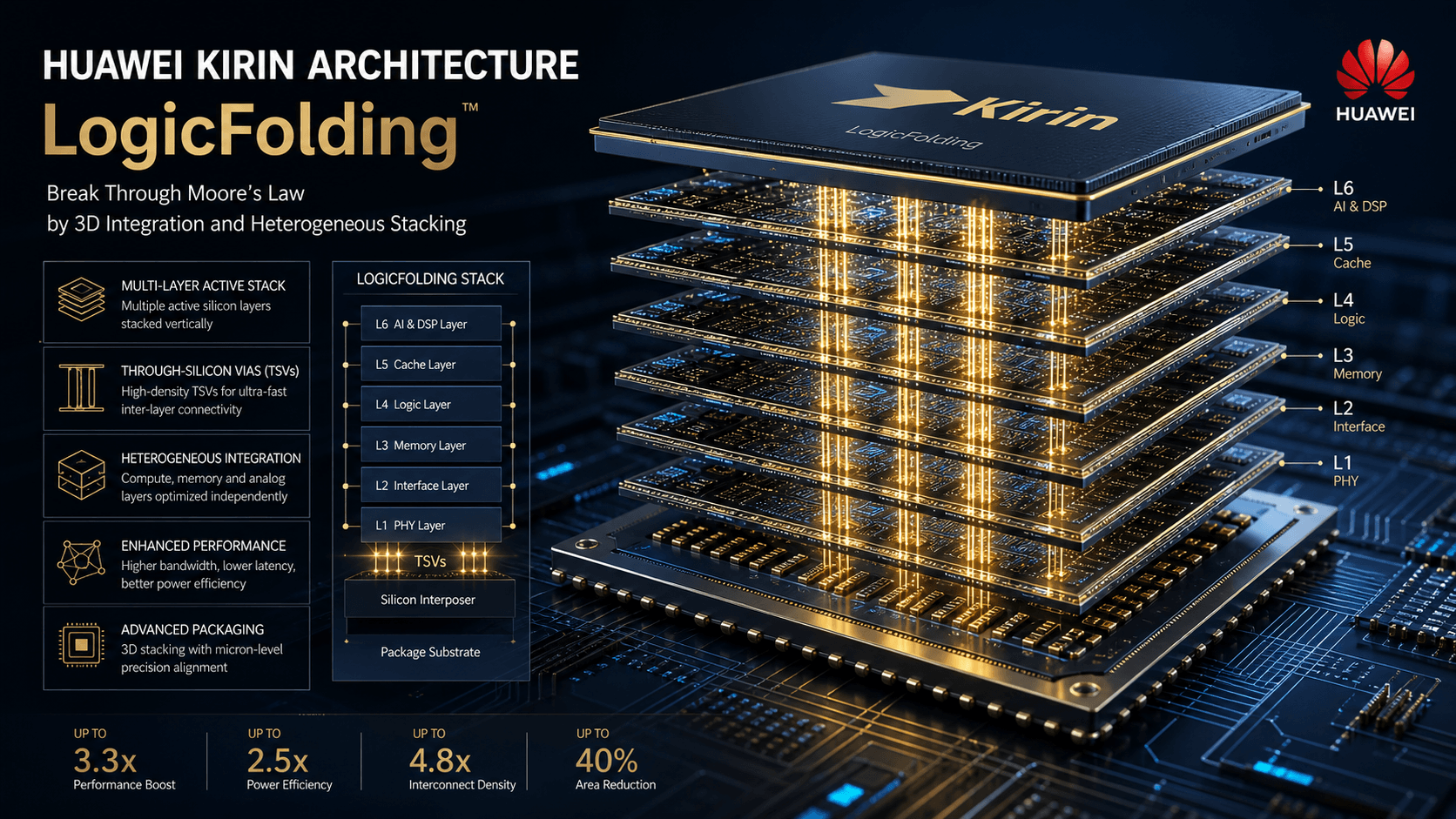
Huawei's He Tingbo has published the Tao's Law V2 paper, introducing a new technique called Logic Folding. This innovation is designed to significantly enhance the performance of Kirin central processing units (CPUs). The core of Logic Folding lies in its ability to dramatically increase transistor density within the chips. According to the paper, this method can boost transistor density by an impressive 53.5%. Such a substantial increase in density is a critical enabler for achieving higher clock speeds. The publication suggests that this advancement paves the way for Kirin CPUs to reach frequencies exceeding 4GHz. This development represents a significant step forward in Huawei's ongoing efforts to improve its in-house chip technology.
The publication of Tao's Law V2 and the introduction of Logic Folding by Huawei highlight a strategic focus on advancing proprietary semiconductor technology. By increasing transistor density, Huawei aims to achieve higher clock speeds, a key metric for CPU performance. This pursuit of in-house innovation is crucial for reducing reliance on external suppliers and enhancing competitive positioning in the global technology market. The long-term implications involve potential shifts in the semiconductor landscape, driven by advancements in materials science and chip architecture. Such developments underscore the ongoing race for technological supremacy in the AI era, where processing power is a critical differentiator.
AI-generated to prompt reflection — not editorial opinion, not advice, not a statement of fact. How this works.