Hubble and Webb Telescopes Detect First "Missing" Black Hole in Star Cluster
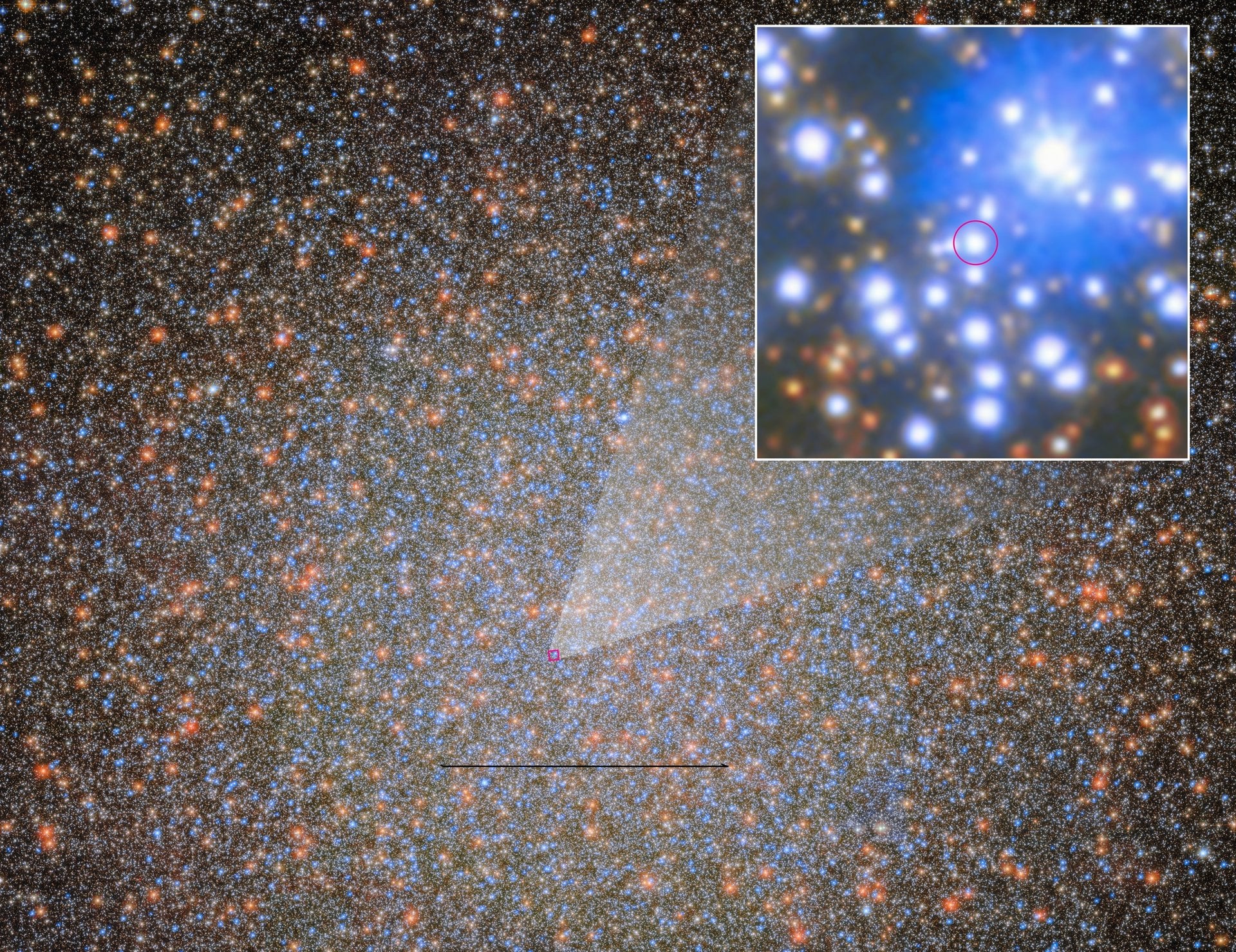
Astronomers have identified the first "missing" black hole, a discovery made possible by combining over two decades of data from the Hubble Space Telescope with new observations from the James Webb Space Telescope. This groundbreaking finding was achieved by a dedicated team of researchers who meticulously analyzed archival information. The identification of this elusive object marks a significant step forward in understanding the population and behavior of black holes within star clusters. Further study of this black hole could provide crucial insights into stellar evolution and the dynamics of dense stellar environments. The successful integration of data from two of the most powerful space telescopes, Hubble and Webb, highlights the synergistic potential of multi-observatory astronomical research. This collaborative effort has opened a new window into previously unobservable phenomena.
The detection of a "missing" black hole, facilitated by the combined power of Hubble and Webb, addresses a long-standing gap in astrophysical models concerning compact object populations within star clusters. This finding prompts a re-evaluation of formation and evolution scenarios for stellar-mass black holes, potentially indicating that current theories may underestimate their prevalence or dispersal mechanisms. Future research will likely focus on the implications for galactic dynamics and the gravitational influence of such objects. Understanding these systems is crucial for refining our comprehension of cosmic structure formation and the lifecycle of stars.
AI-generated to prompt reflection — not editorial opinion, not advice, not a statement of fact. How this works.