Hubble Telescope Identifies First Black Hole in Omega Centauri Star Cluster
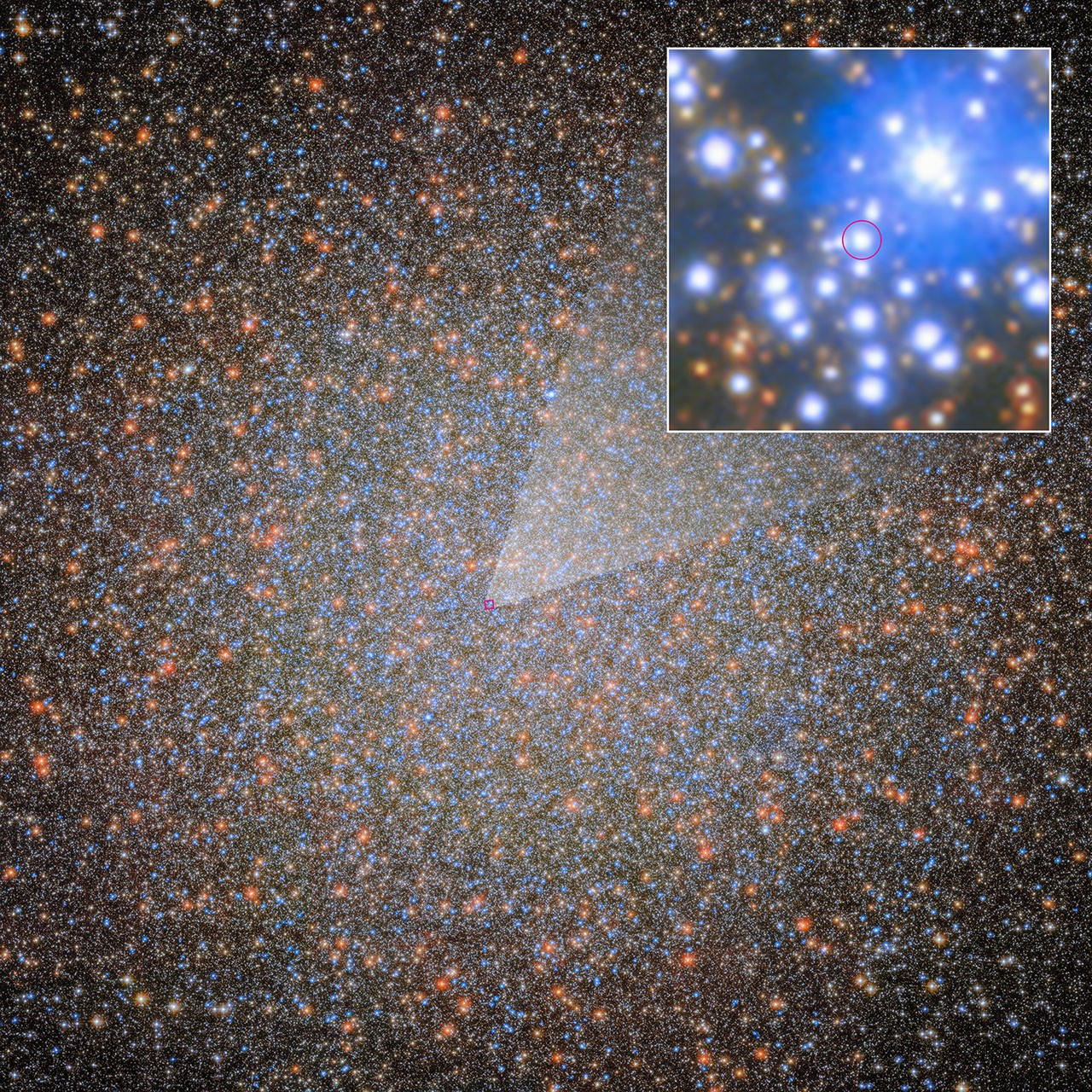
Astronomers have identified the first stellar-mass black hole within the Omega Centauri star cluster, utilizing archival data from NASA's Hubble Space Telescope. This significant discovery was further supported by additional observations from the James Webb Space Telescope. Omega Centauri, a dense collection of stars, is known to be the largest globular cluster in the Milky Way galaxy. The cluster is located approximately 17,000 light-years away from Earth. Scientists have long suspected the presence of black holes within Omega Centauri, but their elusive nature has made direct detection challenging. This finding marks a crucial step in understanding the population and distribution of black holes in such dense stellar environments. The research team analyzed the movements of stars within the cluster to infer the gravitational influence of unseen massive objects. The successful identification provides valuable insights into the formation and evolution of star clusters and their black hole inhabitants. Further studies are expected to leverage both Hubble and Webb to search for more black holes within Omega Centauri and other similar clusters.
The discovery of a stellar-mass black hole in Omega Centauri, confirmed through Hubble and Webb data, highlights the power of combining historical and advanced observational capabilities. This finding addresses a long-standing scientific question regarding the presence of such objects in dense star clusters. Future research will likely focus on refining detection methods for these elusive celestial bodies, potentially revealing a more complete census of black holes in galactic environments. Understanding the population dynamics of black holes within clusters like Omega Centauri could offer critical insights into cluster evolution and the broader landscape of gravitational phenomena in the Milky Way.
AI-generated to prompt reflection — not editorial opinion, not advice, not a statement of fact. How this works.