Hundreds Battle Major Forest Fire South of Paris, 800 Hectares Burned
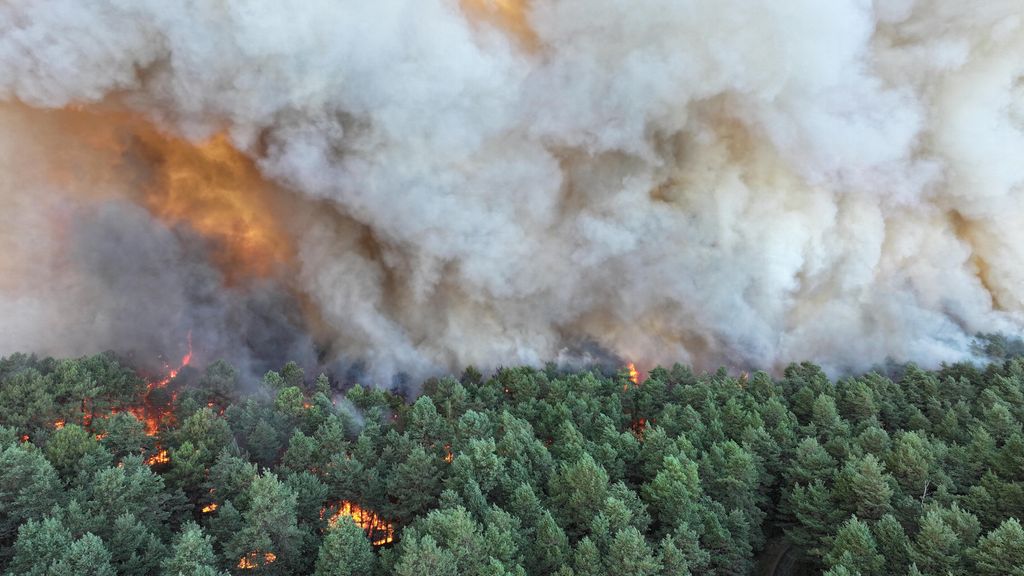
Hundreds of firefighters are currently battling a significant forest fire in Fontainebleau, located southeast of Paris. The blaze has already consumed approximately 800 hectares of land and continues to spread, prompting French authorities to describe it as a fire of "exceptional magnitude." The fire ignited yesterday around 4:40 PM in the Seine-et-Marne department, near the A5 highway, which connects Paris to Lyon. According to a fire department spokesperson, the fire began along the highway and advanced into the forest, leading to the closure of a section of the road. In the village of Le Vaudouë, about fifteen homes have been evacuated, and firefighters are working to protect other nearby communities from the flames. To combat the fire, which is situated 60 kilometers from Paris, authorities have deployed two water-bombing planes, two helicopters, and a reconnaissance aircraft. However, the water-bombing planes had to cease operations after sunset. This marks the first time firefighting planes from southern France have been dispatched to the Paris region for a wildfire. Officials anticipate the fire will not be extinguished quickly, with Lieutenant Colonel Pascal Reversat of the fire department suggesting it could take up to a week to contain. French Interior Minister Nuñez is scheduled to visit Fontainebleau today. The fire in the Fontainebleau forest occurs amidst France's third heatwave of the year, with 37 departments under a red alert and 47 under an orange alert due to extreme temperatures, some reaching 38 degrees Celsius. This weekend also saw other fires in Seine-et-Marne, including one near Châtelet-en-Brie that severely disrupted high-speed train services between Paris and Lyon, causing delays of up to six hours and leading to the closure of the A5 highway in both directions.
This significant wildfire in Fontainebleau, exacerbated by a severe heatwave, highlights the increasing vulnerability of European forests to extreme weather events. The deployment of aerial firefighting resources, including planes from across the country, underscores the scale of the challenge and the strain on emergency services. The event serves as a stark reminder of the need for integrated climate adaptation strategies, including enhanced forest management practices, early warning systems, and robust infrastructure resilience planning. As heatwaves become more frequent and intense due to climate change, such incidents may become more common, necessitating a long-term focus on preventing ignition sources and mitigating the spread of fires in densely populated and ecologically sensitive areas. The response also points to the complex interdependencies between transportation networks, residential areas, and natural landscapes, requiring coordinated planning to minimize disruption and ensure public safety during environmental crises.
AI-generated to prompt reflection — not editorial opinion, not advice, not a statement of fact. How this works.