Interactive Diagrams Explain James Watt's Steam Engine and Industrial Revolution Innovations
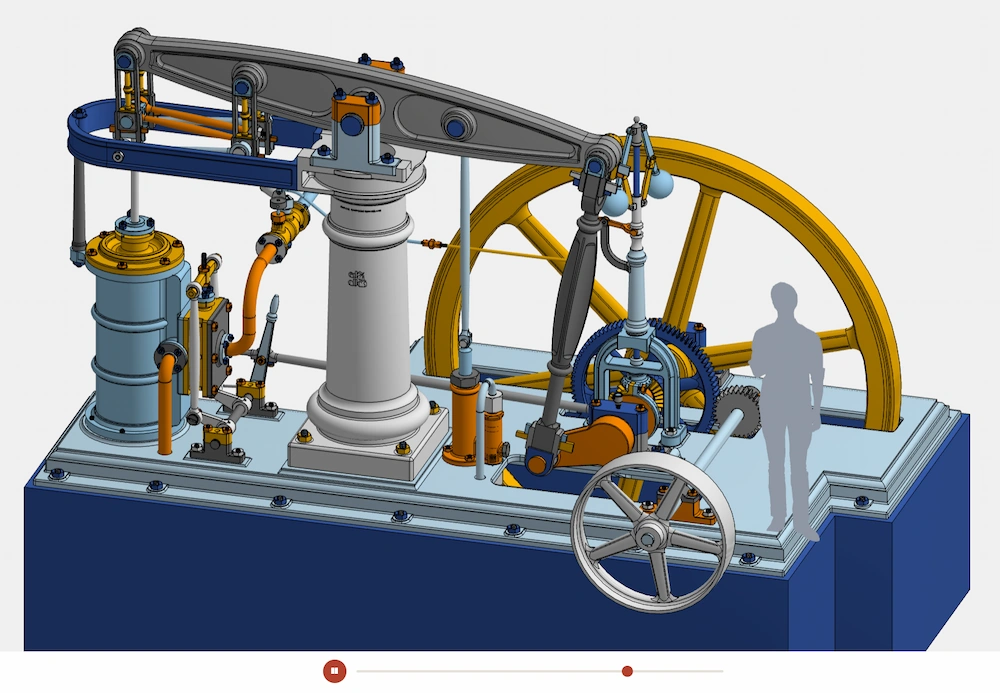
An interactive article by Gary Linscott, titled 'The Rocker Engine,' visually explains the mechanics and principles behind the steam engine, a pivotal invention of the Industrial Revolution. The article details how these machines convert heat energy from burning coal into mechanical motion, covering essential components from the boiler to the flywheel. It highlights key principles such as the expansion of water into steam to generate pressure, the initial use of vacuum and atmospheric pressure in early engines, and James Watt's crucial innovations. Watt's independent condenser, introduced around 1765, significantly reduced coal consumption by 65-70% by preventing continuous cooling and reheating of the cylinder. Further advancements included more efficient steam distribution and mechanisms like connecting rods, crankshafts, and flywheels to convert the piston's reciprocating motion into continuous rotation. The article also discusses the centrifugal governor for automatic speed control and the importance of improved boilers and precision manufacturing for increased power and safety. It traces the evolution of energy efficiency from less than 1% in early engines to over 40% in modern steam turbines, noting that Newcomen's 1712 engine had about 0.5% efficiency, Watt's reached 3%, and late 19th-century engines exceeded 10%. The interactive diagrams allow users to explore each component, including the boiler, piston and cylinder, condenser, slide valve, connecting rod and crankshaft, flywheel, centrifugal governor, and feed pump, making complex concepts accessible for educational purposes or general admiration of human ingenuity.
This interactive explanation of the steam engine highlights a foundational technology that reshaped global economies and societies. The narrative emphasizes the iterative process of innovation, from early designs leveraging atmospheric pressure to Watt's efficiency-boosting condenser and rotational conversion mechanisms. The article implicitly underscores the long-term impact of incremental improvements in energy conversion and mechanical engineering. As we navigate the AI era, understanding such historical technological leaps offers perspective on the systemic changes driven by applied science and engineering, reminding us that significant societal transformation often arises from mastering fundamental physical principles and refining their practical application through persistent engineering effort.
AI-generated to prompt reflection — not editorial opinion, not advice, not a statement of fact. How this works.