Interior Minister Assures Traders of Government Support Amid Security Concerns
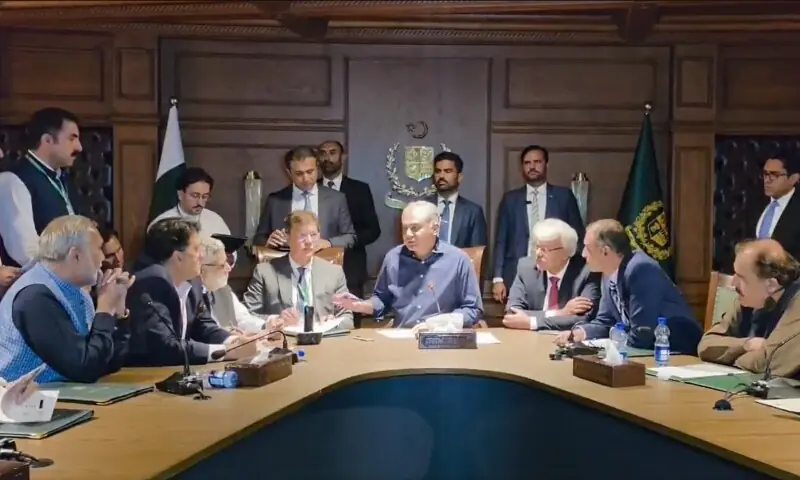
Interior Minister Mohsin Naqvi met with a delegation of traders and industrialists from Khyber Pakhtunkhwa (KP) and Balochistan, pledging the government's full commitment to resolving their issues and ensuring their protection. The business representatives highlighted the prevailing security challenges and operational difficulties in their respective provinces. Minister Naqvi provided an overview of the national security landscape, with a specific focus on KP and Balochistan, detailing the government's countermeasures. He emphasized the crucial role of the private sector in economic stability and progress, assuring the business community of comprehensive cooperation and a commitment to addressing their legitimate concerns. To facilitate this, Naqvi announced upcoming visits to Peshawar and Quetta for detailed discussions with the business community and senior government officials, aiming to devise permanent and practical solutions. This engagement occurs against a backdrop of deteriorating security in Pakistan, particularly in KP and Balochistan, as noted in a recent security assessment. May saw a sharp increase in terrorist violence in these regions, reversing previous improvements. The government has initiated operations such as "Operation Shaban" and "Operation Al-Azm" in Balochistan following significant attacks, including the kidnapping and killing of 27 police officers and a separate incident resulting in three deaths and five injuries. In KP, recent attacks include the martyrdom of nine policemen in Hangu and another policeman in Swat, attributed by authorities to the banned Tehreek-i-Taliban Pakistan. Security forces also thwarted a terrorist attempt at a checkpost in Tank, eliminating 12 militants. Earlier, Minister Naqvi discussed the law and order situation, especially in KP and Balochistan, with President Asif Ali Zardari.
The government's assurance to traders in KP and Balochistan addresses critical economic and security interdependencies. The stated commitment to resolving issues and ensuring protection acknowledges the direct impact of regional instability on business confidence and investment. Future policy effectiveness will likely hinge on the government's capacity to implement sustainable security strategies that go beyond reactive operations, fostering a predictable environment conducive to economic activity. The emphasis on the private sector's role suggests an understanding of market-driven solutions, yet the persistent security challenges indicate a need for integrated approaches that balance security force actions with economic development initiatives to address root causes of instability.
AI-generated to prompt reflection — not editorial opinion, not advice, not a statement of fact. How this works.