International Team Achieves First 8,000m Summit of Summer Season on Nanga Parbat
An international expedition successfully summited Nanga Parbat, an 8,126-meter peak in Gilgit-Baltistan, on Thursday, marking the first successful ascent of an 8,000-meter mountain in Pakistan for the current summer climbing season. The Seven Summit Treks expedition included climbers Tao Hu from China, Antonina Samoilova from Ukraine, Mindaugas Satkauskas from Lithuania, and several from Nepal: Dawa Sherpa, Dendi Sherpa, and Lakpa Temba Sherpa, alongside Pakistani climber Abbas Ali Mehdi. A separate six-member rope-fixing team, also from Seven Summit Treks and primarily composed of Nepali climbers, established the route to the summit prior to the main expedition's ascent.
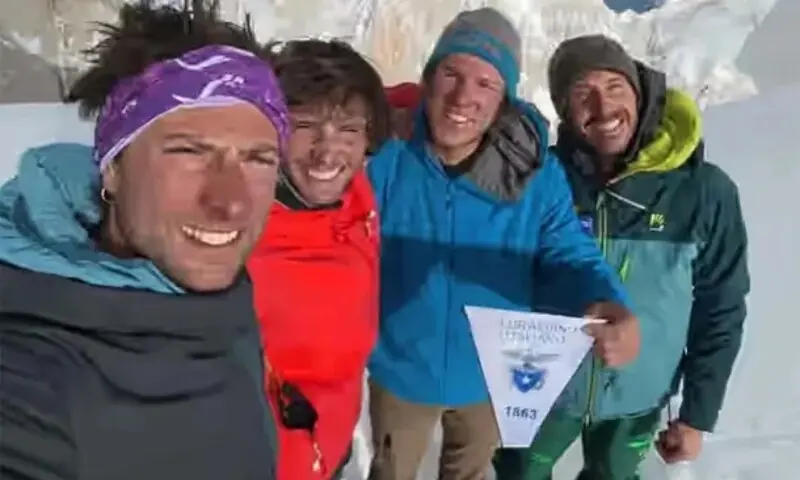
Separately, a four-member Italian expedition, sponsored by the Italian Alpine Club, established a new route on the Southeast Face of K7 (6,934m). The team, consisting of Matteo Della Bordella, Mirco Grasso, Luca Ducoli, and Giacomo Mauri, completed a challenging 1,600-meter big wall climb over six days. However, they were forced to turn back approximately 350 meters below the summit due to hazardous snow and ridge conditions, with a section of the ridge collapsing before their eyes. Despite not reaching the K7 summit, the climbers expressed satisfaction with their accomplishment and safe return to base camp. The Gilgit-Baltistan tourism department has issued 31 mountaineering and 39 trekking permits for the summer season, with issuance continuing until August 1.
The successful Nanga Parbat summit by an international team signifies the reopening of high-altitude climbing in Pakistan for the summer season, attracting diverse nationalities and underscoring the region's appeal. The concurrent new route attempt on K7, though unsuccessful in reaching the summit, highlights the persistent drive for exploration and the inherent risks in mountaineering, where objective dangers like snow instability and ridge collapse can override human endeavor. The issuance of numerous permits indicates a robust tourism sector, balancing economic benefits with the critical need for stringent safety protocols and environmental stewardship in these sensitive alpine environments. Future seasons will likely see continued demand for such expeditions, necessitating ongoing risk management strategies and sustainable operational frameworks.
AI-generated to prompt reflection — not editorial opinion, not advice, not a statement of fact. How this works.