Invisible Dark Matter May Extend Beyond Four Dimensions
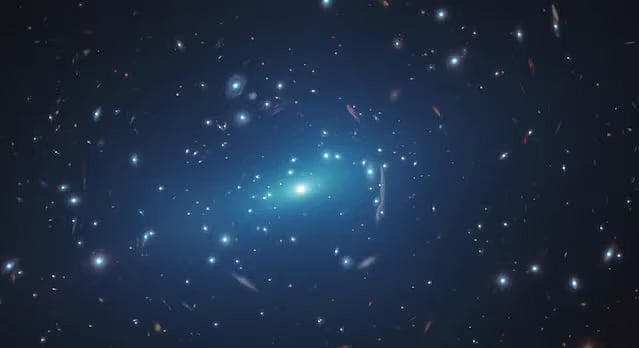
Scientists are exploring the possibility that dark matter, an invisible substance, might not be confined to the familiar four dimensions of spacetime. This enigmatic component of the universe could potentially extend into a fifth dimension. The implications of dark matter existing beyond our observable four dimensions are profound, potentially reshaping our understanding of cosmology and fundamental physics. Researchers are developing new theoretical frameworks and experimental approaches to detect and study this elusive substance. Understanding dark matter's true nature and distribution is crucial for unraveling the universe's structure and evolution. The current models of the universe are heavily influenced by the presence of dark matter, which constitutes a significant portion of its mass-energy content. Further investigation into its dimensional extent could unlock new avenues for physics research and astronomical observation. This exploration challenges existing paradigms and pushes the boundaries of scientific inquiry.
The hypothesis that dark matter may exist in a fifth dimension challenges current cosmological models that primarily operate within a four-dimensional framework. This concept prompts an examination of the limitations of existing observational and theoretical tools, suggesting that our current understanding of dark matter's distribution and influence may be incomplete. Investigating such possibilities could lead to a paradigm shift in physics, potentially resolving anomalies not explained by standard models. The scientific community's pursuit of this idea highlights the ongoing quest to reconcile theoretical predictions with empirical evidence, emphasizing the need for innovative detection methods and theoretical advancements to probe beyond established dimensional boundaries.
AI-generated to prompt reflection — not editorial opinion, not advice, not a statement of fact. How this works.