Iran's Military Resilience Amidst Ongoing US-Israeli Conflict
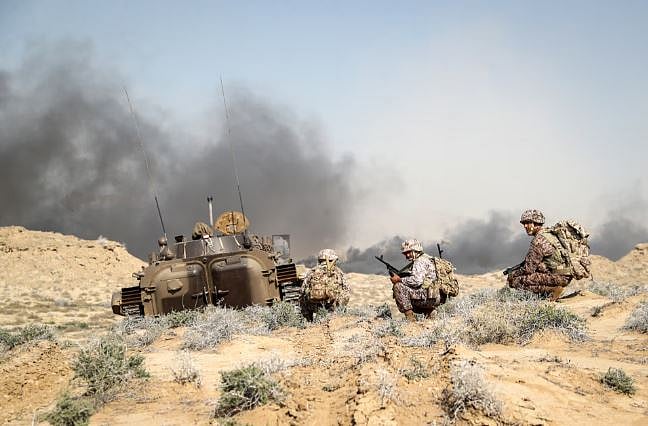
Four months after the commencement of hostilities, Iranian officials are engaged in discussions with the United States in Doha, Qatar, aimed at de-escalating the conflict. Israel, however, strongly opposes these negotiations, which began following a Memorandum of Understanding (MOU) signed on June 17th. Despite the MOU, limited exchanges of fire and threats of renewed conflict persist between the US and Iran. Israel appears particularly eager to launch further large-scale military strikes and destroy Iranian infrastructure, with its Defense Minister, Israel Katz, stating that targets have been identified and the military awaits orders to deploy fighter jets. Katz indicated that if negotiations with Iran prove unfruitful or if Iran attacks Israel, hostilities could resume immediately. The initial invasion on February 28th resulted in the death of Iran's Supreme Leader, Ayatollah Ali Khamenei, who was succeeded by his son, Mojtaba Khamenei, reportedly unseen since the war began. Israel has reportedly identified Mojtaba Khamenei as a target, drawing a swift response from Iran's Foreign Minister, Abbas Araghchi, who vowed immediate and strong retaliation against any threats to Iran's people and leadership. Iran has historically waged an asymmetric war against two of the world's most modern militaries, and its current military capabilities are under scrutiny as the conflict potentially reignites.
During a period of intense attacks lasting less than 40 days, US forces reportedly struck over 13,000 targets within Iran, while the Israeli military claims to have destroyed approximately 4,000 targets in around 10,800 strikes. These attacks targeted senior officials, ballistic and cruise missiles, drone systems, defense industry foundations, air defense systems, and command and communication centers, as well as naval systems, coastal radar, and nuclear facilities. Despite significant losses, including top leadership, Iran's military structure has not collapsed, and it has continued to resist further attacks. While official figures on military damage are undisclosed, satellite imagery and verified reports suggest a systematic campaign to degrade Iran's military capacity, including strikes on drone and missile production facilities, air defense systems, and component factories.
Early in the conflict, Israel claimed to have disabled 60% of Iran's missile launchers and around 250 air defense systems, with significant strikes in Tehran. Key military complexes, naval bases, air bases, and missile sites across Iran were targeted. The US considered a ground invasion but deemed it costly and prolonged. According to US Central Command, over 85% of Iran's ballistic missile, drone, and naval defense industries were destroyed. Iran's aging air force, largely composed of older aircraft due to sanctions, suffered heavy losses, with many planes, helicopters, and refueling aircraft destroyed. US President Donald Trump claimed the destruction of Iran's navy, with over 155 naval vessels reportedly sunk, including the warship 'IRIS Dena.' Attacks also extended to civilian infrastructure, including oil and gas fields, petrochemical plants, steel and aluminum production centers, power plants, universities, and residential buildings. Israel reported destroying 70% of Iran's steel production capacity, impacting missile manufacturing, and over 85% of its petrochemical export capacity. While local authorities are working to partially restore production, full recovery is expected to take years and cost billions. The US naval blockade aimed to halt oil exports, imposing severe economic hardship, though Iran has managed to export significant fuel oil since the blockade's partial withdrawal.
Despite extensive bombing and damage, Iran retains significant military capabilities, particularly its underground missile network, which is largely intact. Many above-ground facilities and tunnel entrances were destroyed but have since been reopened, allowing for the recovery of some weaponry.
The ongoing conflict between Iran, the United States, and Israel highlights the complex geopolitical dynamics and asymmetric warfare strategies employed by nations. While initial assessments suggest significant degradation of Iran's military infrastructure, particularly in its missile, drone, and naval defense sectors, the resilience of its underground facilities and the potential for continued resistance cannot be overlooked. The economic impact of the conflict and sanctions on Iran's population is substantial, creating internal pressures that may influence future strategic decisions. The narrative surrounding the conflict is heavily influenced by national interests and security concerns, necessitating a critical evaluation of claims made by involved parties. Looking ahead, the integration of advanced technologies, the potential for escalation, and the long-term economic stability of the region will be critical factors shaping the trajectory of this protracted confrontation.
AI-generated to prompt reflection — not editorial opinion, not advice, not a statement of fact. How this works.