Iran's New Supreme Leader Vows Retaliation for Father's Assassination
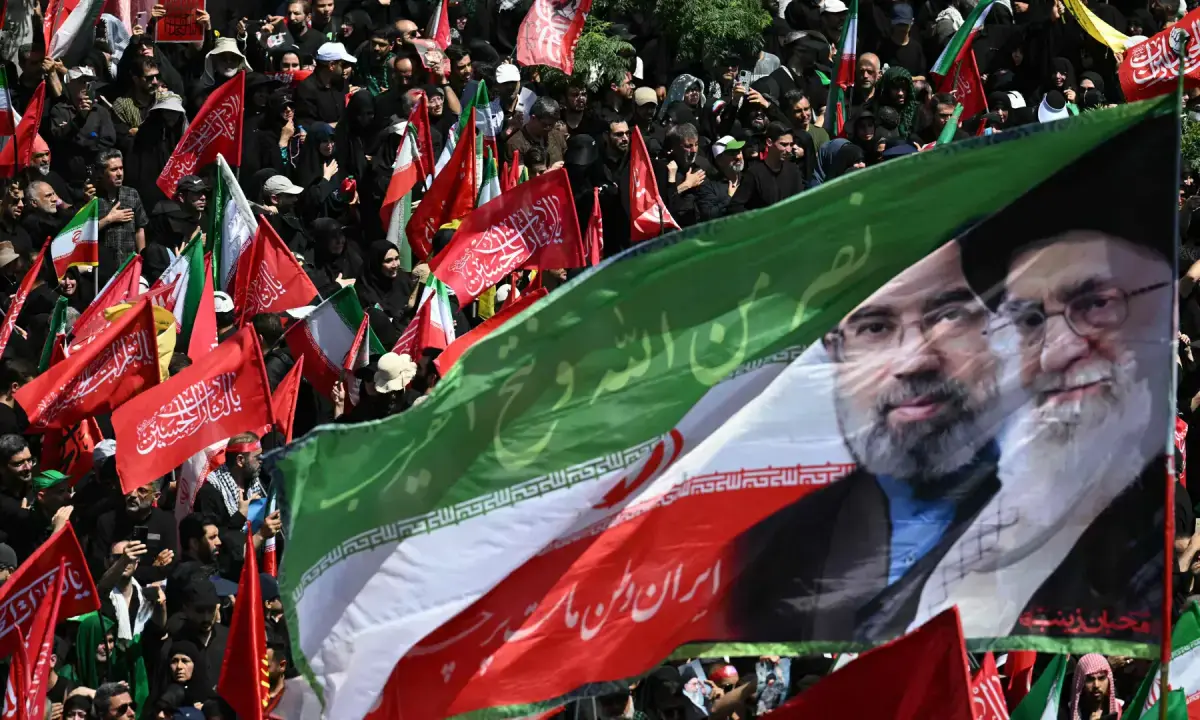
Iran's Supreme Leader Mojtaba Khamenei has pledged revenge for the "US-Israeli killing" of his father and predecessor, Ali Khamenei, who was assassinated by strikes on the first day of the ongoing war. Mojtaba Khamenei stated that vengeance is the nation's will and "must inevitably be carried out," emphasizing that this pursuit is independent of his own life or that of other officials. He indicated that Iran has compiled a list of individuals to be targeted for retribution.
This escalation follows a week of exchanges of fire that jeopardized an interim agreement aimed at ending the conflict, which began on February 28 with significant US-Israeli strikes. President Donald Trump responded to Iran's threats by warning that any attempt to assassinate him would result in the United States "completely decimate[ing]" Iran, claiming "1000 Missiles are Locked and Loaded." Amidst these heightened tensions, mediators, including a delegation from Qatar that visited Iran on Friday, are working to revive diplomatic efforts. Iran's Foreign Minister Abbas Araghchi asserted that Tehran has upheld its commitments under the Islamabad Memorandum of Understanding (MoU) signed on June 18, stating that "mutual compliance" is necessary. The recent strikes, which killed 17 and injured 115 in Iran according to the health ministry, were reportedly triggered by Iran's accusation of vessels deviating from approved routes, leading to US bombing of approximately 90 targets. A significant obstacle to a final resolution remains the future of the Strait of Hormuz, which Iran closed to commercial shipping and plans to charge fees for passage, a stance rejected by Washington under international law. Meanwhile, Iran's chief negotiator Mohammad Bagher Ghalibaf expressed readiness for continued confrontation, stating that the conflict "will never end with Iran’s surrender."
The escalating rhetoric between Iran and the United States, characterized by threats of "decimation" and vows of "inevitable" revenge, highlights the precarious state of regional security and the challenges of de-escalation. The stated intent to target individuals for assassination, if realized, would represent a grave breach of international norms and could trigger further unpredictable retaliatory cycles. From a systemic perspective, the conflict's entanglement with control over critical global energy chokepoints like the Strait of Hormuz underscores the persistent tension between national sovereignty claims and the imperative of free international navigation. As diplomatic efforts appear fragile, the underlying incentive structures driving the conflict—including domestic political pressures, regional power dynamics, and the economic implications of maritime access—will continue to shape the trajectory of events over the next decade, potentially leading to prolonged instability unless a robust, mutually acceptable framework for maritime passage and conflict resolution is established.
AI-generated to prompt reflection — not editorial opinion, not advice, not a statement of fact. How this works.