Iran's President: We Will Defend Our Territory But Won't Expand Conflict
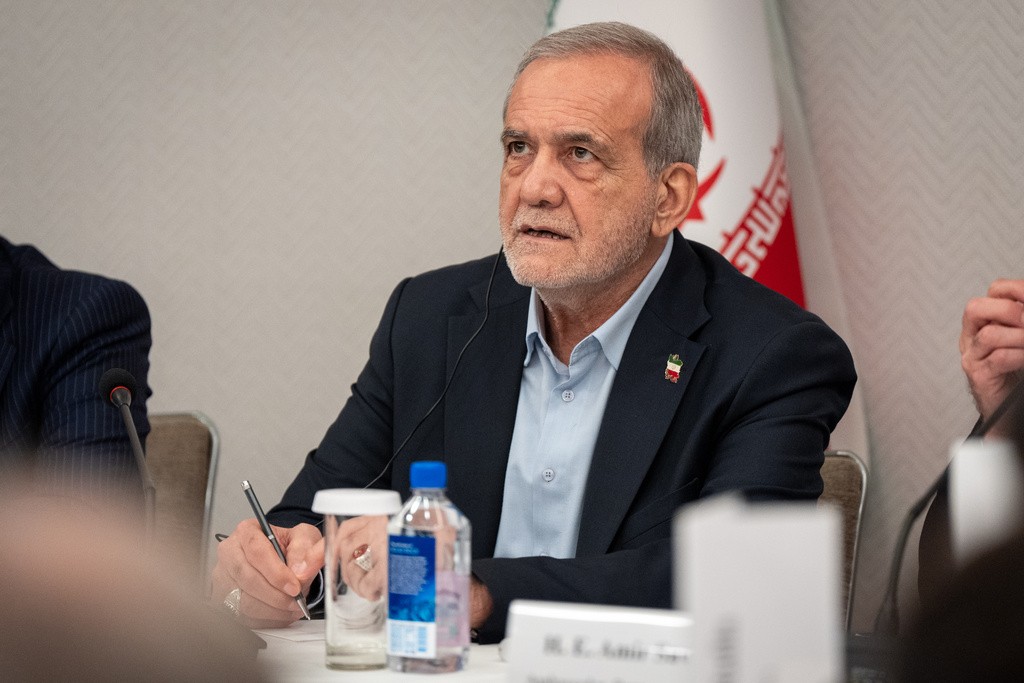
Iranian President Masoud Pezeshkian stated on Tuesday, June 4th, that Iran is committed to defending its territorial integrity but has no intention of escalating the ongoing regional conflict. According to Iranian state media, Pezeshkian emphasized the need to strengthen Iranian society against external threats, asserting that Tehran aims to build a society that offers no temptation for enemies to interfere, infiltrate, or divide the nation. This declaration comes amidst heightened tensions between Iran and the United States.
President Pezeshkian's remarks followed statements by U.S. President Donald Trump, who claimed that Iranian leadership was being "incredibly disingenuous" regarding negotiations. Trump alleged that talks were resuming and presented it as a "last chance" for Iran to reach an understanding, while also asserting U.S. control over the Strait of Hormuz. However, Iranian state media reiterated on Tuesday that Tehran has not planned any talks with the U.S., contradicting Trump's assertions.
This exchange occurs as the conflict between the U.S. and Iran in the Middle East has reached five months without an end in sight. Commercial navigation remains threatened in the Strait of Hormuz and the Bab el-Mandeb strait. Meanwhile, Arab and European countries are reportedly discussing the formation of an international maritime security coalition.
The statements from both Iranian President Pezeshkian and U.S. President Trump highlight a complex geopolitical dynamic characterized by strategic ambiguity and competing narratives. Pezeshkian's assertion of territorial defense without conflict expansion suggests a posture of deterrence, aiming to project strength while signaling a desire to avoid direct confrontation. This approach can be viewed as an attempt to manage domestic and international perceptions, balancing national security imperatives with the economic and social costs of prolonged conflict. Trump's public pronouncements, conversely, appear to employ a strategy of pressure and brinkmanship, leveraging economic leverage and the threat of further escalation to compel concessions. The conflicting accounts of negotiation status underscore the challenges in de-escalation and the potential for miscalculation in a highly volatile region. The ongoing threats to maritime trade routes, particularly through the Strait of Hormuz, represent a critical systemic vulnerability with global economic implications, prompting international discussions on security cooperation.
AI-generated to prompt reflection — not editorial opinion, not advice, not a statement of fact. How this works.
