Iran's Supreme Leader Ayatollah Ali Khamenei's funeral procession begins in Tehran
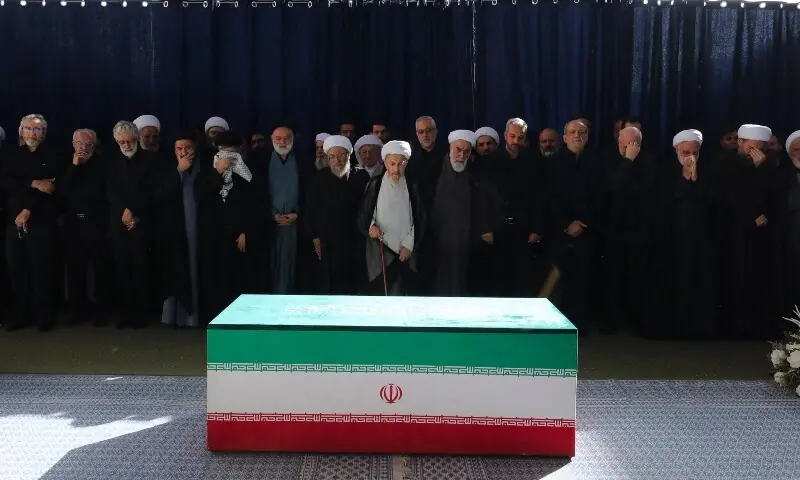
The funeral procession for Iran's Supreme Leader Ayatollah Ali Khamenei commenced in Tehran on Monday, with state television anticipating massive crowds that could rival those for his predecessor in 1989. Khamenei was assassinated on February 28, the first day of the Middle East war, and his body lay in state for two days at the Grand Mosalla religious complex. Mourners gathered in Imam Hussein Square, displaying an effigy of US President Donald Trump. Authorities aim to prevent a repeat of the 1989 funeral chaos for Ayatollah Ruhollah Khomeini, which saw over 10 deaths and 10,000 injuries due to crowd surges. Thousands paid respects on Sunday to Khamenei and four family members, who were reportedly killed in Israeli airstrikes based on US intelligence. Concrete walls were erected to separate the public from the coffin, a measure to prevent stampedes, recalling the 1989 incident where mourners stormed Khomeini's vehicle. The succession remains a focus, with his son, Ayatollah Mojtaba Khamenei, who reportedly took power, not having appeared publicly since his father's death, with officials citing injuries from the airstrikes. The procession will continue to Qom on Tuesday, and then to Najaf and Karbala in Iraq on Wednesday, concluding with burial in Mashhad on Thursday. The new commander of the Revolutionary Guards, Ahmad Vahidi, and the head of the Quds Force, Esmail Qaani, made rare public appearances. Notably absent were surviving predecessors of President Masoud Pezeshkian, who had past tensions with Khamenei. The government seeks to demonstrate national unity and support following recent protests, with vengeance being a prominent theme at the ceremonies, as mourners called for punishment for Khamenei's killers. Delegations from groups like Hamas and Hezbollah, supported by Iran, attended the events.
The events surrounding the assassination and subsequent funeral of Iran's Supreme Leader Ayatollah Ali Khamenei highlight the complex interplay of internal succession politics, regional geopolitical tensions, and state efforts to project national unity. The emphasis on mass mobilization and calls for revenge serve to consolidate domestic support and signal resolve to external actors amidst ongoing regional conflict. The focus on the unconfirmed public appearance of the successor, Mojtaba Khamenei, underscores the inherent fragility of leadership transitions in such environments, particularly when coupled with claims of external aggression. Future governance will likely be shaped by the balancing act between maintaining internal cohesion through nationalist sentiment and navigating the volatile international landscape, with potential implications for regional stability and Iran's foreign policy trajectory over the next decade.
AI-generated to prompt reflection — not editorial opinion, not advice, not a statement of fact. How this works.