Iran Thanks Pakistan for Abstaining on UN Security Council Nuclear Program Meeting
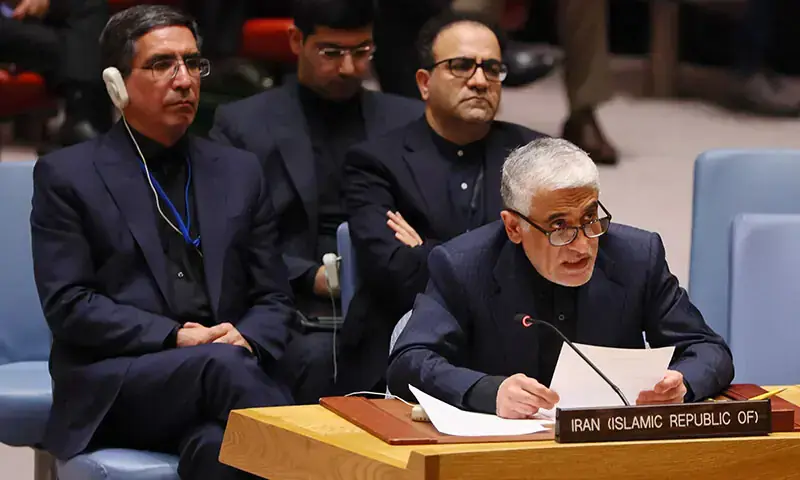
Iran expressed gratitude to Pakistan and Somalia on Friday for abstaining from a vote that permitted a UN Security Council meeting to convene regarding its nuclear program. Iran's Ambassador and Permanent Representative, Amir Saeid Iravani, stated that these nations did not support the meeting's convocation, while also commending Russia and China for opposing it. The meeting, requested by Bahrain and five European council members (Denmark, France, Greece, Latvia, and the UK), aimed to discuss the implementation of Resolution 2231, which underpins the 2015 Iran nuclear agreement, and the UN Secretary-General's recent report. Iran contends that Resolution 2231 expired on October 18th of the previous year and thus lacks legal standing for reports, briefings, or discussions under the 'Non-Proliferation' agenda item. Ambassador Iravani also criticized the European powers' invocation of the "snapback" sanctions mechanism, arguing that France, Germany, and the UK had themselves failed to uphold their commitments under the Joint Comprehensive Plan of Action (JCPOA). He asserted that a party in material breach of its obligations cannot leverage rights from the same agreement. Furthermore, he accused the United States and Israel of violating international law through military actions against Iran and called for their accountability. Iravani reiterated that Iran's nuclear program remains peaceful and subject to extensive IAEA verification, denying any diversion to military purposes. He also alleged that Western countries were politicizing the Security Council, distorting facts and misrepresenting Resolution 2231. Regarding maritime security, he stated that Iran alone holds responsibility for navigation and demining operations in the Strait of Hormuz, warning that external interference could escalate regional tensions.
This event highlights the complex geopolitical dynamics surrounding Iran's nuclear program and its international standing. The UN Security Council meeting, despite Iran's objections to its legality, underscores the persistent concerns of Western nations and their allies regarding nuclear proliferation. Iran's strategic thanking of abstaining nations suggests an effort to cultivate diplomatic support and counter isolation, leveraging the council's procedural nuances. The dispute over Resolution 2231's validity and the "snapback" mechanism reveals a fundamental disagreement on treaty interpretation and enforcement, reflecting broader tensions in international law application. Iran's assertion of its peaceful nuclear activities and its accusations against the US and Israel point to a narrative of self-defense and external provocation. Looking ahead, the efficacy of international monitoring and diplomatic engagement will be crucial in navigating these challenges, with potential implications for regional stability and global non-proliferation efforts.
AI-generated to prompt reflection — not editorial opinion, not advice, not a statement of fact. How this works.