Itatiaia National Park Records Year's Lowest Temperature at -7.7°C
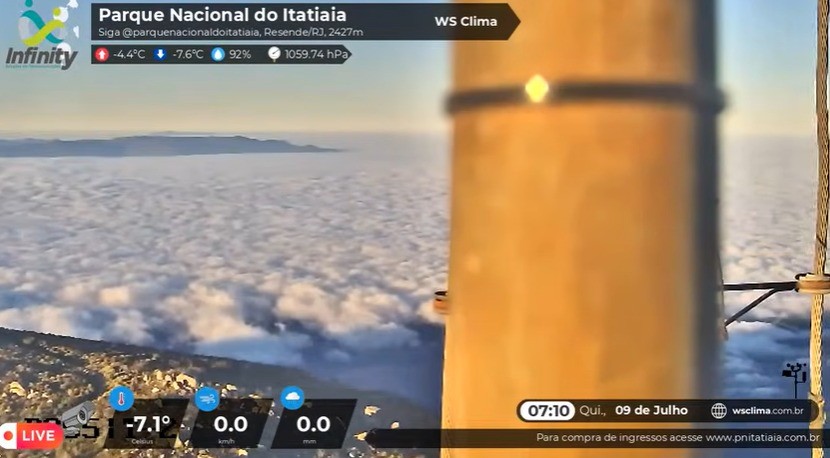
The Itatiaia National Park in Brazil recorded its lowest temperature of the year on Thursday morning, reaching -7.7 degrees Celsius. The extreme cold was observed at the Nascente Campo Belo RJ/MG station, which recently resumed operations. This station is situated in one of the park's highest and coldest regions, near the source of the Itatiaia River. Drone footage captured the park's vegetation covered in frost, appearing 'painted white'. The minimum temperature was recorded between 4:39 AM and 6:10 AM. Later in the morning, temperatures remained significantly low, with readings of -7.1°C at 7:10 AM and -6.6°C at 7:30 AM. The park currently holds the top two positions in the daily low-temperature rankings compiled by WS Consultoria Climatológica, a partner of the National Institute of Meteorology (Inmet). Established in June 1937, Itatiaia National Park was Brazil's first national park. Located in the Serra da Mantiqueira mountain range, it spans across Rio de Janeiro and Minas Gerais states, bordering São Paulo. Its boundaries include the municipalities of Itatiaia and Resende in Rio de Janeiro, and Itamonte and Bocaina de Minas in Minas Gerais. The park's area has expanded from an initial 12,000 hectares to 28,000 hectares since its creation. Characterized by mountainous terrain and rock formations, its highest point is Pico das Agulhas Negras, standing at 2,791.5 meters, making it the fifth-highest peak in Brazil.
The extreme cold event in Itatiaia National Park highlights the significant temperature variations possible within Brazil's diverse geography, particularly in high-altitude regions. This occurrence underscores the importance of robust climate monitoring infrastructure, such as the Nascente Campo Belo station, which has recently been brought back online. Such data is crucial for understanding microclimates and informing conservation strategies for sensitive ecosystems within national parks. Looking ahead, as global climate patterns shift, understanding the frequency and intensity of such extreme cold snaps, alongside heatwaves, will be vital for predicting ecological impacts and adapting land management practices in protected areas.
AI-generated to prompt reflection — not editorial opinion, not advice, not a statement of fact. How this works.