Jamaat-e-Islami Accuses Government of Ignoring Referendum Mandate
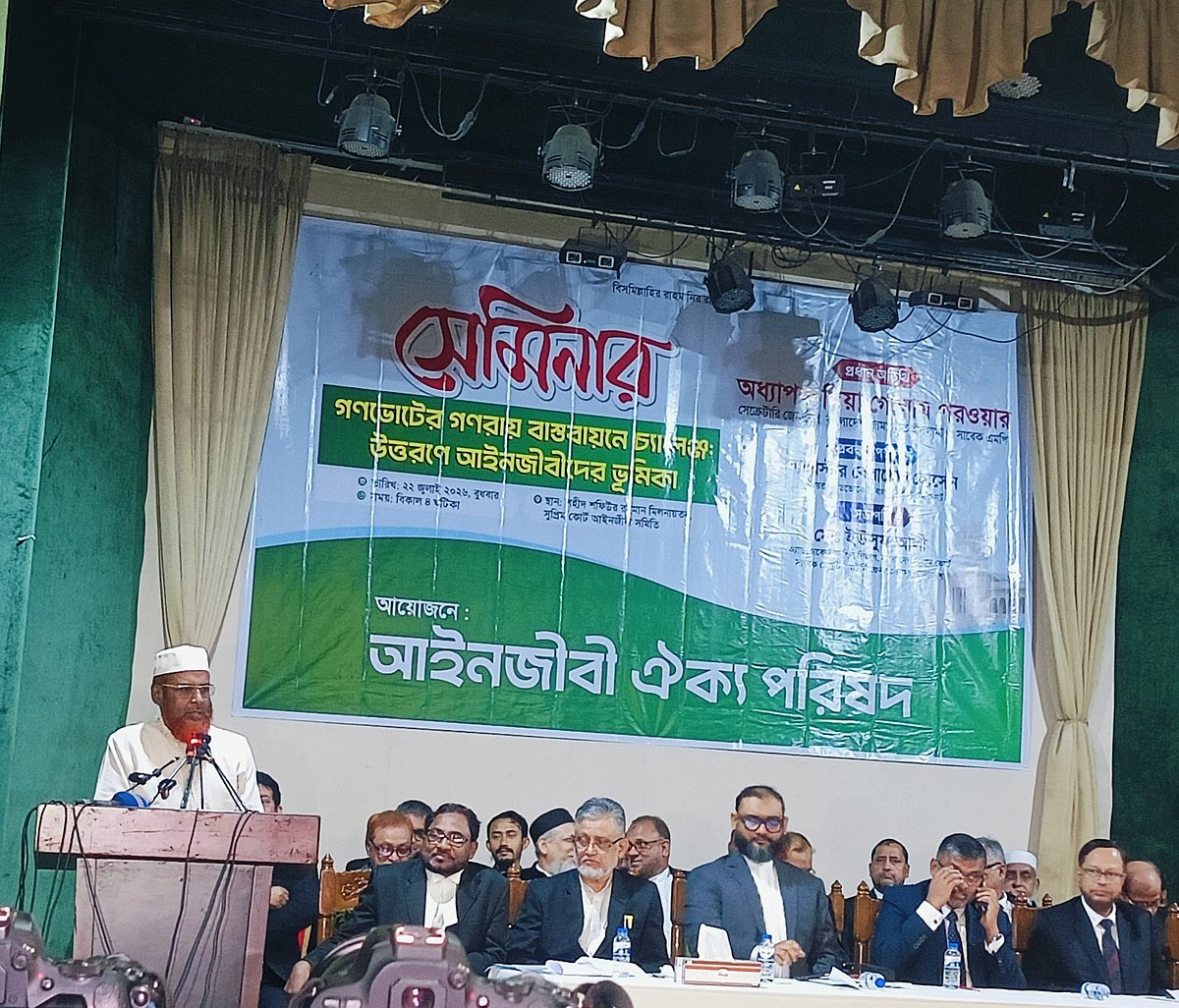
Jamaat-e-Islami Secretary General Mia Ghulam Parwar has accused the government of agreeing to the July Accord but refusing to honor the mandate of a referendum. He stated that the constitution's spirit, vision, and entire structure need fundamental change to dismantle authoritarian rule, politicization, and corruption. Parwar argued that such reforms would prevent future authoritarian or one-party systems, which is why the government is resisting the referendum's outcome. He made these remarks at a seminar titled 'Challenges in Implementing the Referendum's Verdict: Lawyers' Role in Overcoming Them,' organized by the Lawyers' Unity Council at the Supreme Court Bar Association building. Parwar recalled that registered political parties involved in the anti-fascist movement had signed the July Accord through a consensus commission, implying prior agreement. He questioned the government's current reversal on this commitment. The Jamaat leader also claimed that the BNP aims to return to past authoritarian governance, viewing the July Accord as a major obstacle, and has formed a parliamentary special committee to amend the constitution to circumvent it. Parwar pointed out that while the government repeatedly pledges to uphold the July Accord, they avoid committing to accepting the referendum's verdict. Senior Supreme Court lawyer Sisir Monir discussed the constitution's transitional provisions, suggesting that if the president could issue orders during the 1972-73 transitional period, similar actions should be possible during the upcoming period from August 5, 2024, to February 12, 2025, unless the government provides valid legal reasons otherwise. Member of Parliament Mir Ahmad Bin Kashem Arman asserted that the implementation of the July Accord and constitutional amendments are being used for public deception, and the referendum's outcome must be fully implemented, whether through parliament or public mobilization.
The discourse surrounding the July Accord and the referendum highlights a fundamental tension between established political processes and the perceived will of the electorate. The Jamaat-e-Islami's critique suggests a potential disconnect between stated governmental commitments and actual policy implementation, particularly concerning mechanisms for public consultation and decision-making. This situation raises questions about governance transparency and the robustness of democratic institutions in translating popular mandates into legislative action. Future political stability may depend on clarifying the legal and constitutional pathways for incorporating referendum outcomes into national policy, ensuring that such processes are perceived as legitimate and binding, thereby mitigating potential conflicts arising from differing interpretations of political agreements and public consent.
AI-generated to prompt reflection — not editorial opinion, not advice, not a statement of fact. How this works.