Jamaat-i-Islami to Form Kashmir Peace Council for AJK Dialogue
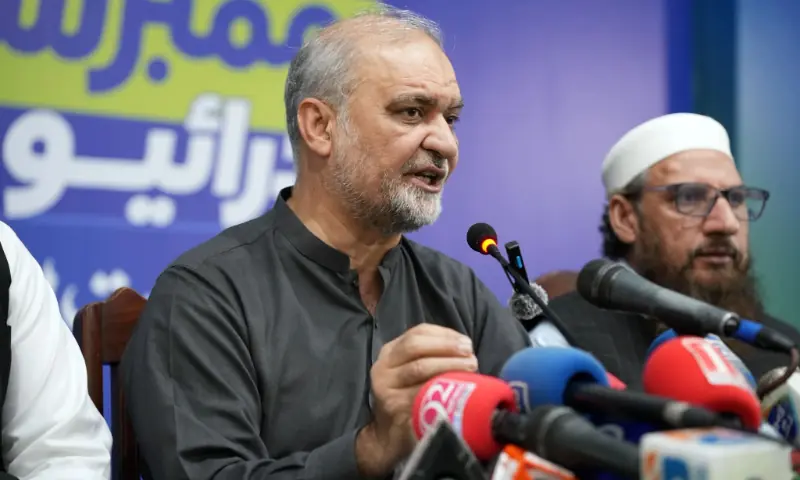
Jamaat-i-Islami (JI) announced on Sunday its decision to establish a "grand" Kashmir peace jirga aimed at facilitating dialogue between the Azad Jammu and Kashmir (AJK) government and the banned Joint Awami Action Committee (JAAC). This initiative seeks to restore stability and normalcy in the region, which has experienced significant unrest. The decision was formalized during a JI central Majlis-i-Shura meeting in Lahore, chaired by JI Emir Hafiz Naeemur Rehman. The jirga's primary objectives will be to engage both parties and prioritize the resolution of issues in AJK.
A committee led by JI Deputy Emir Liaqat Baloch has been formed to oversee this effort, including JI AJK Emir Dr Muhammad Mushtaq Khan and former regional chiefs Abdul Rashid Turabi and Dr Khalid Mahmood. This committee is slated for expansion to incorporate former civil bureaucrats, retired judges, ex-military officials, and civil society members from AJK. The JI expressed grave concern over the escalating situation in AJK, warning of negative repercussions for the broader Kashmir cause and emphasizing that no compromise is acceptable on this issue.
Rehman urged the federal government to initiate immediate negotiations, highlighting dialogue as the sole viable path to de-escalate the crisis. He characterized Kashmir as Pakistan's "jugular vein" and advised the state to act as a supportive guardian rather than allowing tensions to mount, cautioning against the risk of another internal conflict given existing challenges in Balochistan and Khyber Pakhtunkhwa. The committee plans to visit Rawalakot soon to engage with JAAC leaders. Regarding the controversy over 12 reserved seats in the AJK Legislative Assembly for refugees, Rehman acknowledged the legitimacy of some protester concerns but maintained that representation for refugees from Indian Illegally Occupied Jammu and Kashmir and the occupied territory itself is non-negotiable and should be resolved through talks. The JAAC, declared a proscribed organization on June 5, has been in conflict with the regional administration over demands, including the abolition of these reserved seats. Recent clashes on June 9 resulted in at least one death and several injuries.
This initiative by Jamaat-i-Islami to mediate between the AJK government and the JAAC reflects a strategic effort to address regional instability, framing it as a matter of national security and the integrity of the Kashmir cause. By proposing a peace jirga, JI positions itself as a neutral facilitator, aiming to de-escalate tensions and foster dialogue. The analysis of the situation highlights the complex interplay of political representation, historical grievances, and security concerns within the AJK. The JI's emphasis on dialogue, while seemingly constructive, also serves to reinforce its role as a significant political actor in matters pertaining to Kashmir. The underlying incentive structure for JI appears to be enhancing its influence and projecting an image of national responsibility, particularly in the context of ongoing security challenges in other Pakistani regions. The long-term implications depend on the willingness of both the AJK government and the JAAC to engage constructively, and whether this mediation can navigate the deep-seated issues surrounding representation and governance without exacerbating existing divisions.
AI-generated to prompt reflection — not editorial opinion, not advice, not a statement of fact. How this works.