Jantar Mantar: Where Celestial Movements Align with Power
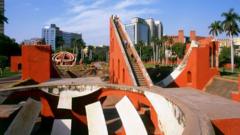
Jantar Mantar in New Delhi is an ancient astronomical observatory where celestial bodies and their movements are observed. The site, characterized by its ochre stones, stands as a testament to historical scientific endeavors. As the sun rises over Connaught Place, its shadow slowly moves across the stones of Jantar Mantar, symbolizing the passage of time and the enduring nature of astronomical observation. The observatory's instruments were designed to measure celestial positions and movements with remarkable accuracy for their era. Its historical significance lies not only in its scientific function but also in its connection to the pulse of power, suggesting a historical interplay between astronomical knowledge and governance. The narrative invites readers to explore the rich history and scientific legacy of Jantar Mantar.
Jantar Mantar represents a fascinating intersection of ancient astronomical science and the historical centers of power in Delhi. The observatory's design and function highlight a time when understanding celestial mechanics was intrinsically linked to governance, possibly for calendrical purposes, astrological insights, or establishing authority through knowledge. In the context of the AI era, such historical sites prompt reflection on how humanity's relationship with data, prediction, and control has evolved. While ancient tools measured physical celestial movements, modern AI analyzes vast datasets to predict complex systems, raising questions about the nature of knowledge, its application, and the potential for both enlightenment and manipulation across different technological epochs. The enduring presence of Jantar Mantar serves as a reminder of humanity's persistent quest to understand and chart the universe, a quest now amplified by computational power.
AI-generated to prompt reflection — not editorial opinion, not advice, not a statement of fact. How this works.