John Pardon Awarded Fields Medal for Groundbreaking Work on Knot Theory
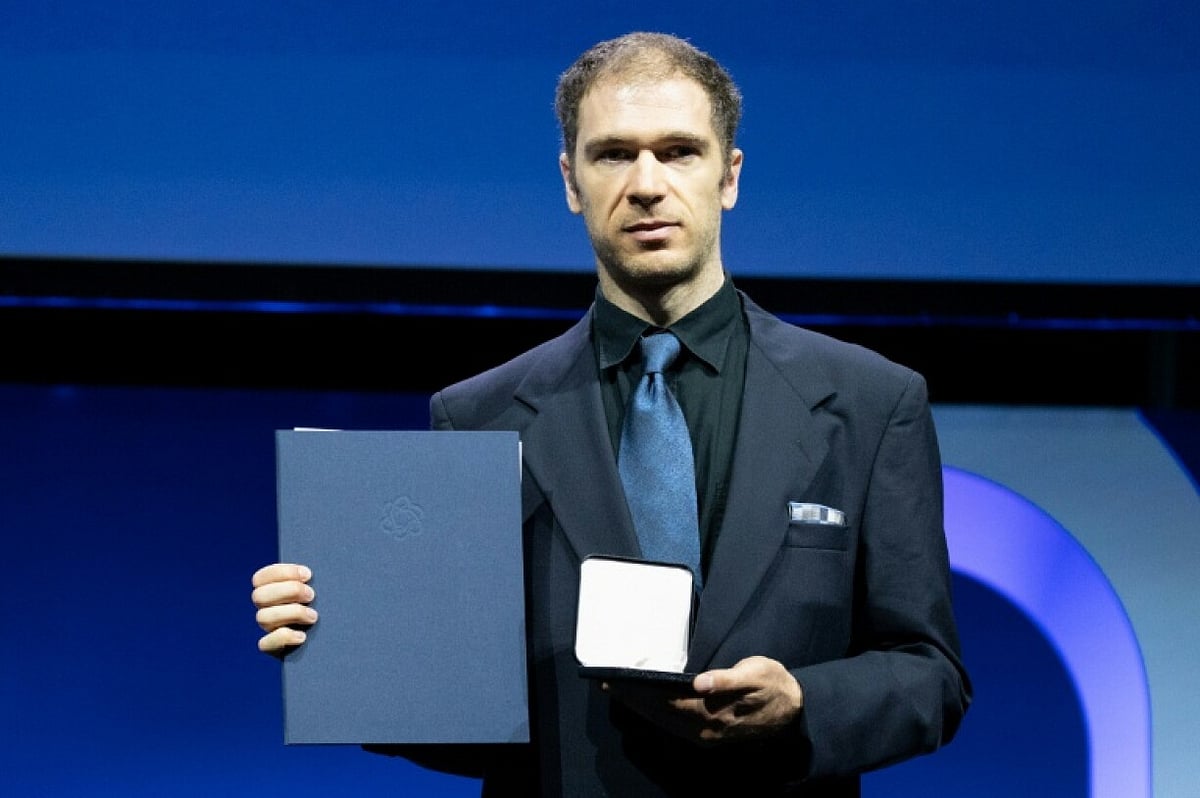
American mathematician John Pardon has received this year's Fields Medal, the highest honor in mathematics, for his significant contributions to the study of knot theory. The Fields Medal is awarded to mathematicians under the age of 40 who have made exceptional achievements. Pardon, 37, is recognized as a distinguished topologist for his work on the mathematical concept of knots, which are loops or twists in a string that cannot be undone without cutting it. His research addressed a complex question posed by mathematician Mikhail Gromov in 1983: whether any twisted loop, regardless of its complexity, can be contained within a specific degree of bending. Pardon mathematically proved that this is not possible, bridging geometry, topology, and physics. Pardon's academic journey began early, with his first research paper published while he was in high school in North Carolina. He pursued his undergraduate studies at Princeton University, where he published further papers and achieved early success. His doctoral advisor at Stanford University, Yakov Eliashberg, noted that Pardon's greatest strength lies not just in proving theorems, but in his profound ability to grasp the fundamental structure of mathematical problems. Beyond mathematics, Pardon is known for embracing difficult challenges, including becoming proficient in Mandarin Chinese, a language he now uses to communicate with his sons, Alexandros and Andreas.
This narrative highlights a mathematician whose work on abstract concepts like knot theory has profound implications, demonstrating how seemingly esoteric mathematical problems can have real-world relevance and attract significant academic recognition. The award of the Fields Medal underscores the value placed on fundamental theoretical advancements. Pardon's ability to tackle complex problems and his personal pursuit of challenging skills, such as learning Mandarin, suggest a cognitive flexibility and dedication that are often prerequisites for high achievement. Examining this through a futurist lens, the increasing complexity of systems, from tangled supply chains to intricate biological networks, suggests that mathematical tools for understanding and resolving such complexities will become even more critical. The challenge for educational and research institutions is to foster environments that encourage deep theoretical exploration while also making these advanced concepts accessible and relevant to broader societal challenges.
AI-generated to prompt reflection — not editorial opinion, not advice, not a statement of fact. How this works.