JWST's Red Dots: New Theory Explains Origin of Globular Clusters
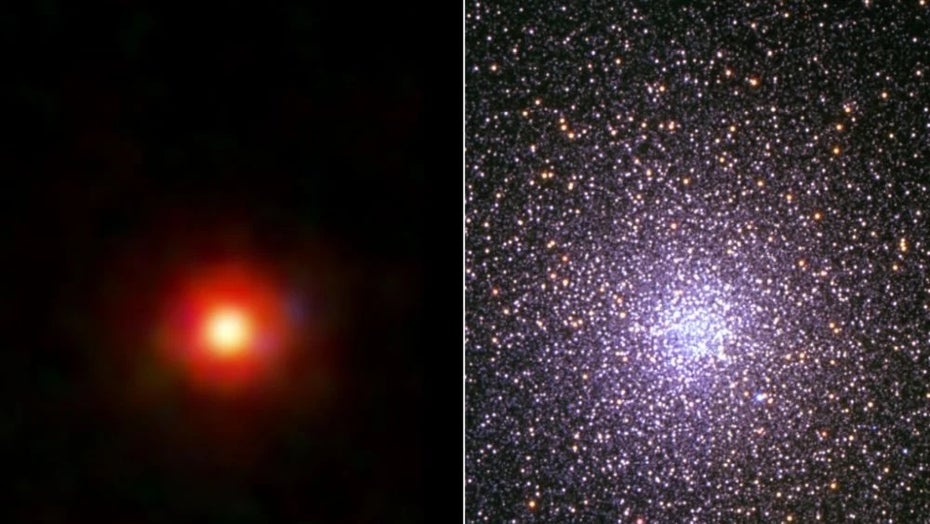
The James Webb Space Telescope (JWST) is providing data that continues to puzzle astronomers. A new theory may offer a surprising yet elegant solution to the mystery of tiny luminous dots observed in the early universe. These observations challenge existing models of cosmic evolution. The JWST's advanced capabilities allow for unprecedented views of the distant universe, revealing phenomena that require new theoretical frameworks. The research focuses on understanding the formation and evolution of globular clusters, which are dense collections of stars. These ancient structures are crucial for understanding the early stages of galaxy formation. The new theory proposes a novel mechanism that could explain the characteristics of these early globular clusters. Further data analysis and observational campaigns are expected to validate or refine this groundbreaking hypothesis.
The JWST's observations of early cosmic structures are pushing the boundaries of astrophysical understanding, necessitating the development of new theoretical models. This situation highlights the iterative nature of scientific progress, where advanced instrumentation reveals phenomena that challenge established paradigms. The pursuit of understanding globular clusters in the early universe is critical for reconstructing the timeline of galaxy formation and stellar evolution. Future research will likely focus on corroborating these findings with additional data and refining theoretical frameworks to accommodate these novel observations, potentially reshaping our comprehension of cosmic origins.
AI-generated to prompt reflection — not editorial opinion, not advice, not a statement of fact. How this works.