Karachi Buildings Fail Fire Safety: Over 300 Lack Extinguishers, Many Without Exits
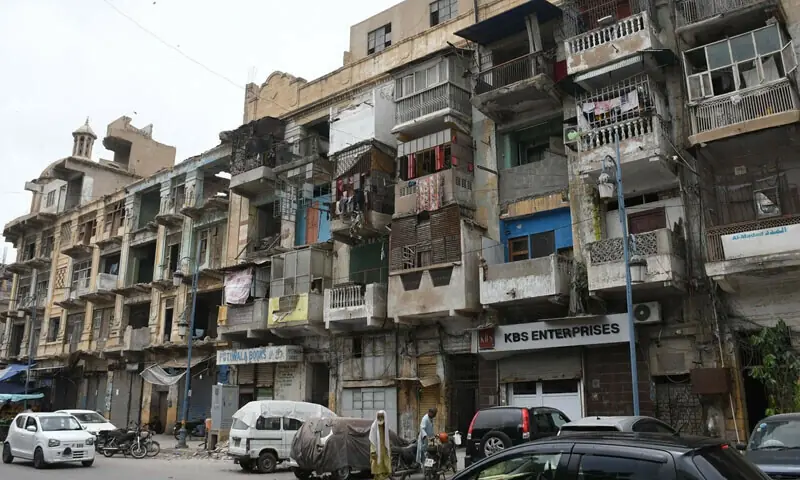
A fire safety audit of 783 commercial and residential buildings across Karachi's seven districts has revealed widespread non-compliance with basic safety standards, raising significant concerns about emergency preparedness. The survey, ordered by the provincial government after a deadly fire in January, found that only 370 buildings, approximately 47%, demonstrated substantial compliance with fire safety regulations. A total of 416 buildings were found to be lacking emergency exits, and a staggering 310 buildings did not have any fire extinguishers. Furthermore, 408 buildings did not adhere to approved layouts, and 455 were not constructed according to plan. Overall, 239 buildings were classified as high risk.
District Central and District South showed particularly alarming results, with high numbers of non-compliant structures and critical safety equipment deficiencies. District Central reported 103 high-risk buildings and very few equipped with emergency exits or fire extinguishers. District South had 65 high-risk buildings and significant shortfalls in both emergency exits and extinguishers. Conversely, districts like Keamari and Korangi showed better compliance rates, though Korangi still had notable gaps in safety equipment despite a high number of approved layouts. Officials noted that deviations from approved layouts can obstruct evacuation routes during emergencies.
This audit highlights a critical systemic failure in urban governance and building code enforcement within Karachi. The widespread non-compliance, particularly the absence of basic safety equipment like fire extinguishers and emergency exits in hundreds of buildings, suggests a profound disconnect between regulatory intent and on-the-ground implementation. Factors such as inadequate inspection mechanisms, potential corruption, or a lack of accountability for developers and building owners likely contribute to this dangerous situation. The findings underscore the urgent need for robust oversight, transparent enforcement, and potentially a re-evaluation of the penalties for non-compliance to incentivize adherence to safety standards. Without significant intervention, Karachi remains vulnerable to catastrophic events, especially as the city's population and density continue to grow.
AI-generated to prompt reflection — not editorial opinion, not advice, not a statement of fact. How this works.