Kashmir Leaders Protest in Delhi, Demand Restoration of Statehood
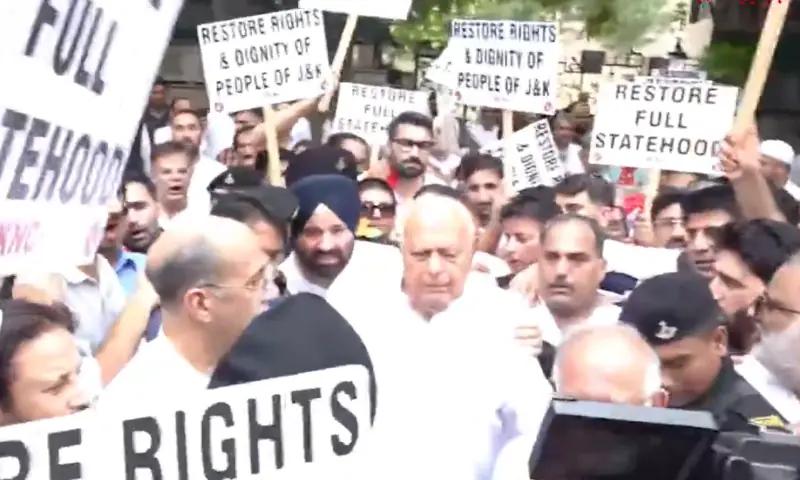
Hundreds of people, led by the Chief Minister of India-occupied Kashmir (IoK), Omar Abdullah, protested in Delhi on Monday, demanding the restoration of statehood for the region. The demonstration occurred seven years after India revoked IoK's autonomy by abrogating Article 370. Police prevented the protesters from reaching their intended demonstration site, as reported by Abdullah on X, where he shared images and videos of the protest. Abdullah stated that this protest marks the "beginning of our struggle for statehood, our rights, our dignity and everything that was taken away from us." In August 2019, Prime Minister Narendra Modi's government revoked the partial autonomy of Jammu and Kashmir, removed its statehood, and divided it into two federally controlled territories. The government has indicated that statehood will be restored at an "appropriate time" but has not provided a specific deadline. Abdullah and his party, the Jammu and Kashmir National Conference, are urging for the earliest possible restoration of statehood, aligning with the government's stated commitment. Deputy Chief Minister Surinder Choudhary expressed disappointment, stating, "It is the misfortune of the people of Jammu and Kashmir that today we have to come to Delhi to protest and remind our Prime Minister Narendra Modi and Home Minister Amit Shah of their promise." Choudhary highlighted that despite promises to restore statehood after elections, over a year and a half has passed without fulfillment. Leaders from Modi's Bharatiya Janata Party (BJP) have suggested the protest aims to distract from alleged governance issues within Abdullah's administration.
This event highlights the ongoing tension between regional aspirations for autonomy and the central government's approach to governance in disputed territories. The protest underscores a perceived gap between political promises and their implementation, particularly concerning the restoration of statehood and rights. From a systems perspective, the situation reflects a challenge in balancing national security imperatives with democratic expectations of self-governance and timely fulfillment of electoral commitments. The government's stated intention to restore statehood at an "appropriate time" suggests a strategic calculus that may prioritize stability or other political objectives over immediate policy changes. Future developments will likely be shaped by the interplay of regional political pressure, central government policy shifts, and the evolving geopolitical landscape concerning the region.
AI-generated to prompt reflection — not editorial opinion, not advice, not a statement of fact. How this works.