Keiko Fujimori Elected Peru's First Female President After 15-Year Bid
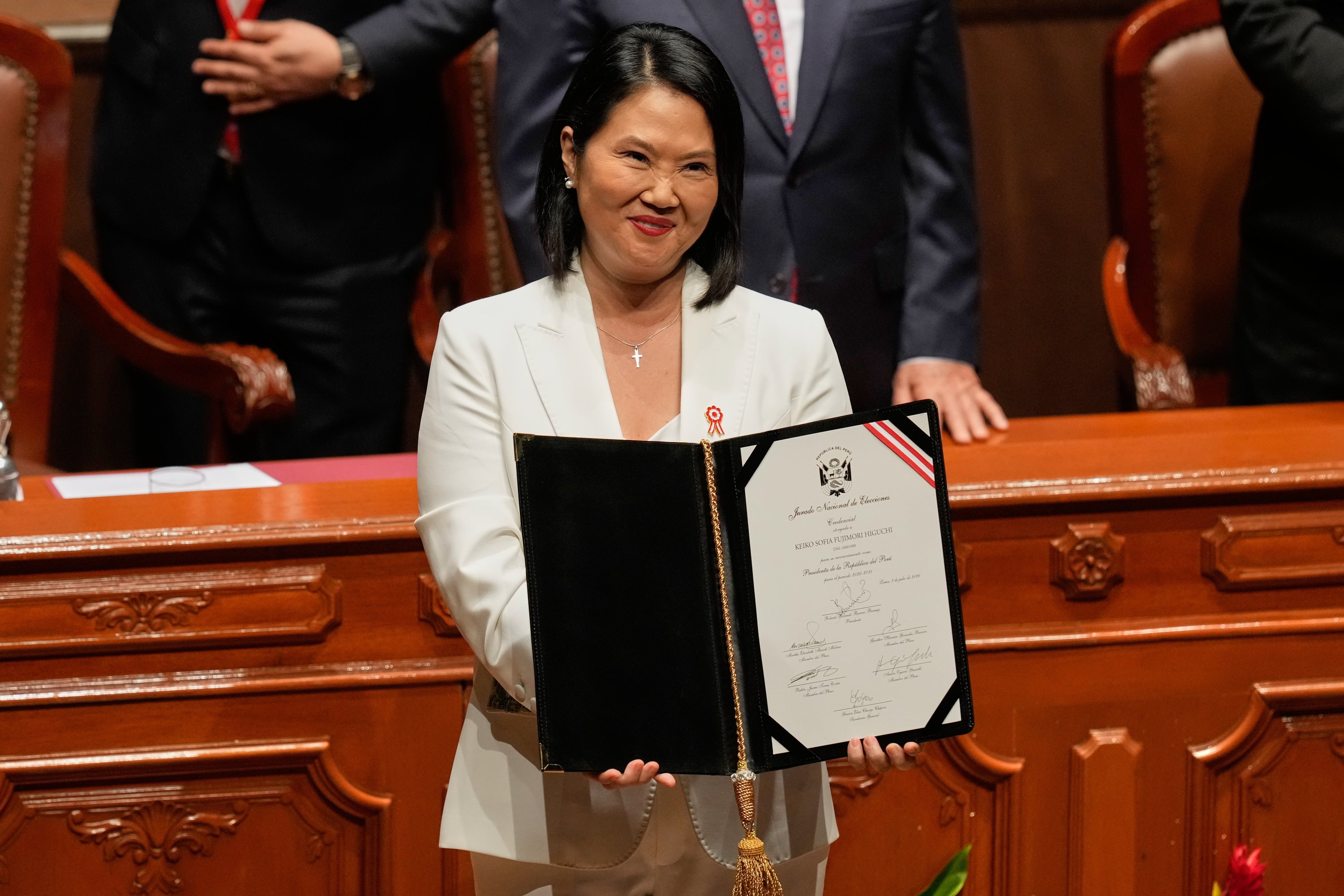
After 15 years of attempts, Keiko Fujimori has been elected as Peru's first female president, securing the 2026-2031 term. Her campaign garnered 9,223,396 votes, representing 50.13% of the valid ballots. Her rival, Roberto Sánchez, who has contested the results and called for street demonstrations and international action, received 49.86% of the vote. This marks the third consecutive presidential election in Peru decided by fewer than 50,000 votes, with a difference of only 49,641 votes separating the two candidates.
Fujimori, who will assume office on the 28th of this month, won in only nine of Peru's 25 regions. Her victory was largely due to overseas voters; she secured an 81,655-vote lead in consulates and embassies, which proved decisive for her overall win. This marks Fujimori's fourth presidential candidacy, having previously lost in the second round three times to Ollanta Humala, Pedro Pablo Kuczynski, and Pedro Castillo. Her government plan, "Perú con orden," focuses on security, the economy, and social issues, and she will also need to address public healthcare access, educational quality, corruption, and regional inequalities.
The incoming president's security proposals, emphasizing a strong hand and a return to order reminiscent of her father's era, are seen by citizens as a swift solution to the country's overwhelming problems. Regarding economic policy, sources within her party, Fuerza Popular, have indicated an intention to retain Julio Velarde as head of the Central Reserve Bank, a move interpreted by markets as a signal of continuity in monetary policy. Fujimori faces the monumental task of unifying a deeply polarized nation, rebuilding public trust in institutions, and establishing her own distinct leadership style focused on modernization, economic growth, legal certainty, investment, and social inclusion. The reintroduction of a bicameral legislature, with a Chamber of Deputies and a Senate, presents an opportunity for consensus-building in a fragmented Parliament where no single party holds a majority, necessitating constant dialogue. Her return to power after 26 years offers a chance to strengthen institutions and prioritize national needs over partisan interests, potentially restoring democratic stability.
Keiko Fujimori's election signifies a complex moment for Peru, reflecting persistent public concerns about security and economic stability, alongside a deep-seated desire for order. The narrow margin of victory and regional disparities in support highlight the nation's profound polarization. Fujimori's challenge lies in navigating this division, balancing her party's agenda with broader national needs, and distinguishing her leadership from her father's legacy. The economic implications, particularly regarding the Central Reserve Bank, suggest a market preference for continuity, yet the success of her 'Perú con orden' platform will depend on effective governance and inclusive policies. The re-establishment of a bicameral legislature may foster greater deliberation, but also requires skillful negotiation to overcome partisan gridlock. Her administration's ability to foster trust and deliver tangible improvements across all regions will be critical in shaping Peru's trajectory over the next decade, particularly in an era demanding adaptable and equitable governance.
AI-generated to prompt reflection — not editorial opinion, not advice, not a statement of fact. How this works.