Kenyan Footprints Reveal Prehistoric Social Dynamics of Paranthropus boisei
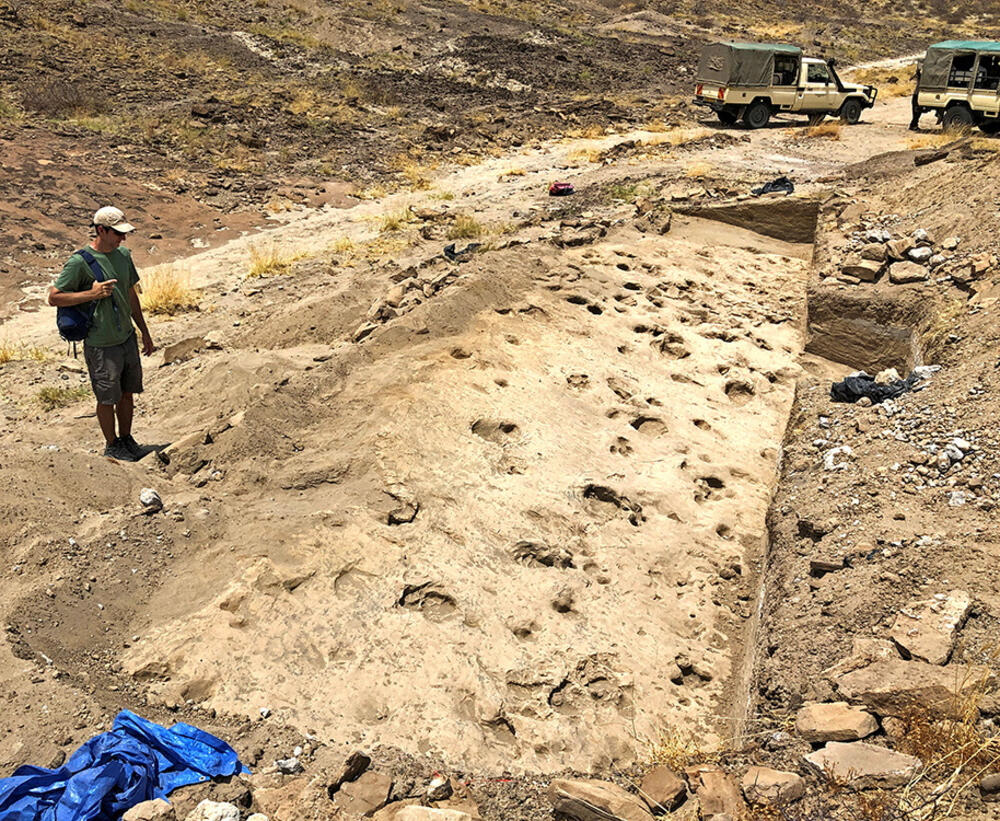
Fossilized footprints discovered in Kenya are offering unprecedented insights into the social behavior of the ancient hominin species Paranthropus boisei. These tracks provide evidence that male individuals sometimes traveled together in groups, separate from females and young offspring. This finding challenges previous assumptions about the social structures of early human relatives. The footprints suggest a more complex social organization than previously understood, indicating that group composition varied depending on activity or context. Researchers are analyzing the gait and spacing of the prints to infer more about the locomotion and group dynamics of these prehistoric beings. The site's preservation offers a rare snapshot into the daily lives and interactions of Paranthropus boisei millions of years ago. Further study of these prints is expected to shed more light on the evolutionary path of hominins and the development of social behaviors within our ancestral lineage.
The discovery of these footprints provides valuable empirical data for understanding hominin social structures, moving beyond speculative models. Analyzing the composition of traveling groups, such as males moving independently, can inform theories on resource competition, territoriality, and mating strategies within Paranthropus boisei. This evidence highlights the importance of paleoanthropological fieldwork in reconstructing the complex tapestry of early human evolution, emphasizing that social dynamics were likely diverse and context-dependent, rather than monolithic. Future research could explore how environmental pressures or resource availability might have influenced these varied group formations, offering a more nuanced perspective on survival strategies in the Pliocene epoch.
AI-generated to prompt reflection — not editorial opinion, not advice, not a statement of fact. How this works.