Korean AI Model Scores All Driving Paths for Safety Before Vehicle Moves
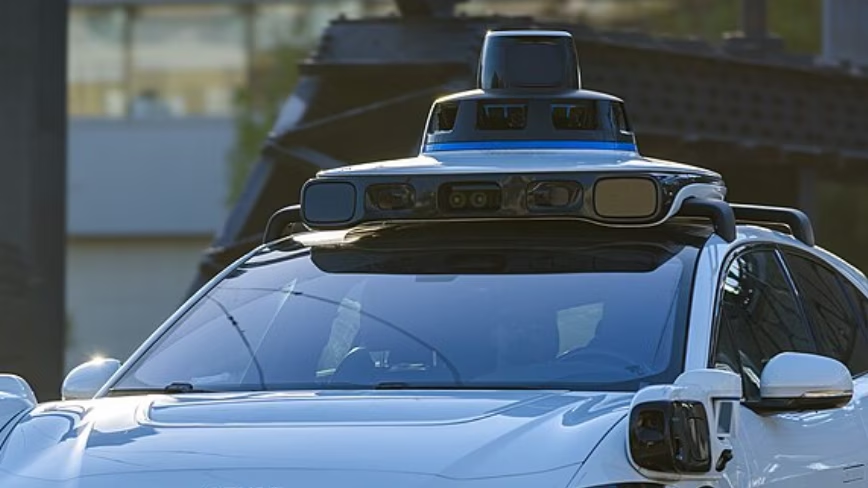
A team at Seoul National University, led by Professor Jun Won Choi, has developed a novel artificial intelligence model for autonomous vehicles. Unlike most self-driving AI that learns by mimicking human driving behavior, this new model takes a different approach. It evaluates every possible driving path and assigns a safety score to each before the car even begins to move. This method aims to address a critical limitation of current AI systems: their difficulty in explaining the rationale behind their decisions, especially when split-second choices lead to errors. The innovation was recognized at the CVPR conference, where it was highlighted as a significant development. The research promises to enhance the transparency and reliability of self-driving technology by providing a clear, pre-emptive safety assessment for every potential maneuver.
This development in autonomous driving AI shifts focus from imitation to explicit safety verification. By scoring all potential paths before motion, the system aims to provide a more robust and explainable decision-making process, crucial for safety-critical applications. This approach could mitigate risks associated with emergent behaviors in complex environments, where mimicking human driving might not always yield the safest outcome. The challenge lies in computational efficiency and ensuring the scoring mechanism accurately reflects real-world driving hazards across diverse conditions. As AI systems become more integrated into public infrastructure, such transparent and pre-emptive safety protocols will be vital for regulatory approval and public trust.
AI-generated to prompt reflection — not editorial opinion, not advice, not a statement of fact. How this works.