Korean Sign Language Depicts LGBTQ+ People with Sex Act; Activists Demand Inclusive Dictionary.
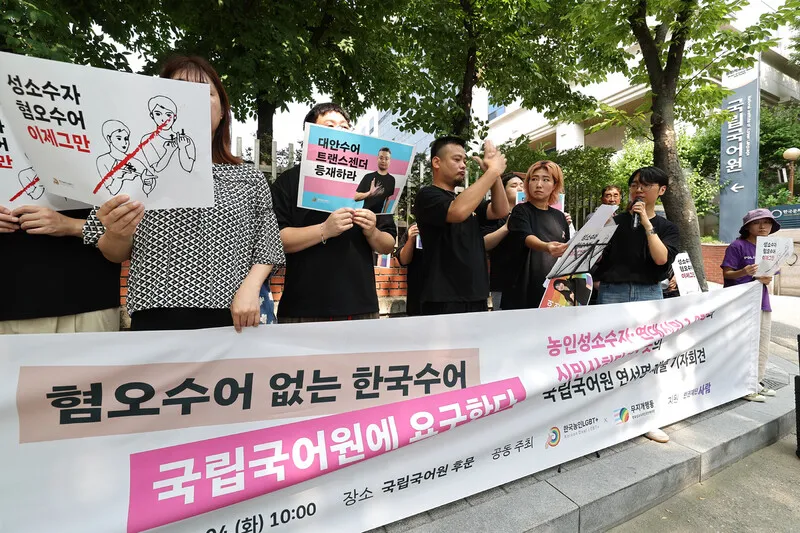
A sign in Korean Sign Language (KSL) that represents sexual minorities by depicting a sexual act has drawn criticism. Advocates are calling for the removal of this offensive sign and the inclusion of respectful, non-discriminatory terminology in the official KSL dictionary. They argue that the current depiction is dehumanizing and perpetuates harmful stereotypes against the LGBTQ+ community. The demand highlights a broader issue of inclusivity and representation within language systems. Activists emphasize the need for official dictionaries to reflect societal progress towards equality and respect for all individuals, regardless of their sexual orientation or gender identity. They believe that language, particularly in its formalized forms, plays a crucial role in shaping public perception and fostering an inclusive society. The push for change aims to ensure that KSL accurately and respectfully represents all members of the community it serves. This movement seeks to align the official lexicon with principles of human rights and dignity.
The controversy surrounding the Korean Sign Language depiction of sexual minorities raises critical questions about linguistic representation and inclusivity. The use of a sign associated with a sexual act to represent an entire community can be seen as reducing individuals to a single aspect of their identity, potentially perpetuating harmful stereotypes and marginalization. This situation underscores the importance of ongoing review and revision of official language resources to ensure they align with evolving societal values of respect and non-discrimination. As AI and digital technologies become more integrated into communication, the need for inclusive and accurate language representation in all forms, including sign language, becomes even more pronounced. Future efforts should focus on developing and adopting terminology that is both descriptive and respectful, fostering a more equitable and understanding society.
AI-generated to prompt reflection — not editorial opinion, not advice, not a statement of fact. How this works.
