Letterpaths: Free Open-Source Tool for Learning and Practicing Calligraphy
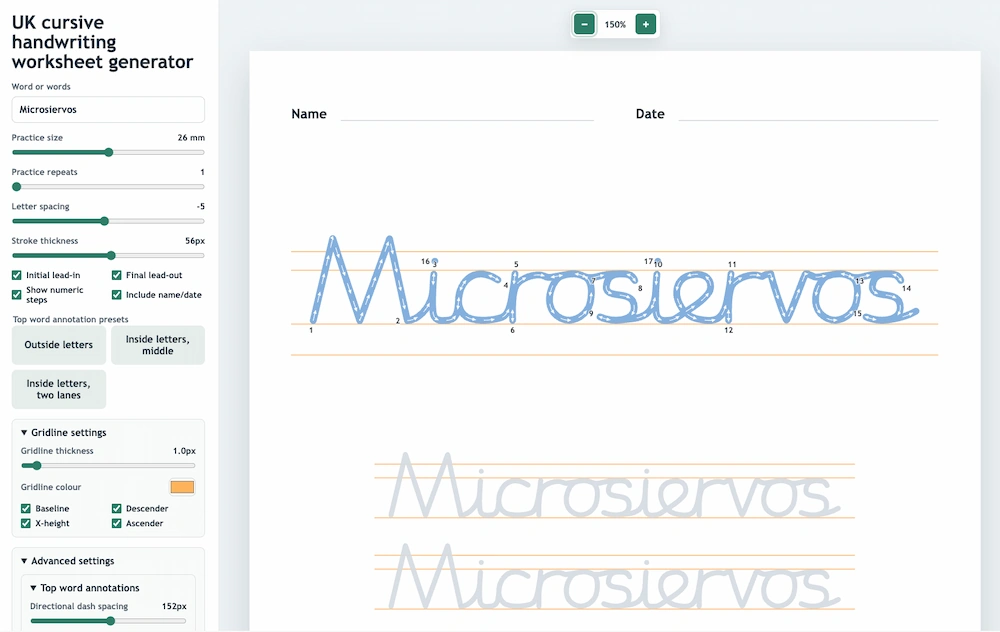
Letterpaths is a free, open-source collection of tools designed to help users learn and practice calligraphy. Originally developed for primary school children in the UK, it is adaptable for various languages beyond English. The platform requires no registration and is ad-free, allowing users to generate custom worksheets for printing or direct screen practice with names or vocabulary words. It offers specific generators for practicing both cursive (joined-hand) script, common in Spain and known from resources like Cuaderno Rubio, and print (block) letters, prevalent in the UK. The tools incorporate techniques for letter formation, including directional arrows, numbered starting points, and guide lines (baseline, ascenders, descenders) to promote correct writing gestures. Additional applications enable users to trace letters and words on-screen or practice freehand writing, with a system that assesses stroke accuracy. A unique feature is the 'constellation game,' which teaches letters by connecting them like stars. Letterpaths also provides a linked cursive font that can be downloaded in .OFT, .TTF, or .WOFF2 formats for use in documents and presentations. As an open-source project, Letterpaths encourages community contribution, allowing anyone to study, modify, or adapt it for different languages and writing styles. This adaptability could facilitate the creation of specialized versions for teaching calligraphy in Spanish or other languages, aligning with local letter models and conventions, and integration into broader educational projects.
Letterpaths exemplifies how open-source initiatives can democratize access to educational tools, particularly for foundational skills like handwriting. By providing a customizable and free platform, it addresses potential barriers related to cost and accessibility in traditional learning methods. The project's open-source nature fosters a collaborative environment, enabling adaptation for diverse linguistic and pedagogical needs, which is crucial in a globalized educational landscape. This model challenges proprietary educational software by demonstrating the viability of community-driven development for specialized learning resources. Future iterations could explore AI-driven personalized feedback for stroke correction or adaptive learning pathways based on user performance, further enhancing its utility as a modern educational technology.
AI-generated to prompt reflection — not editorial opinion, not advice, not a statement of fact. How this works.