LLM 0.32 Release Enhances AI Capabilities with Reasoning Traces and Server-Side Tools
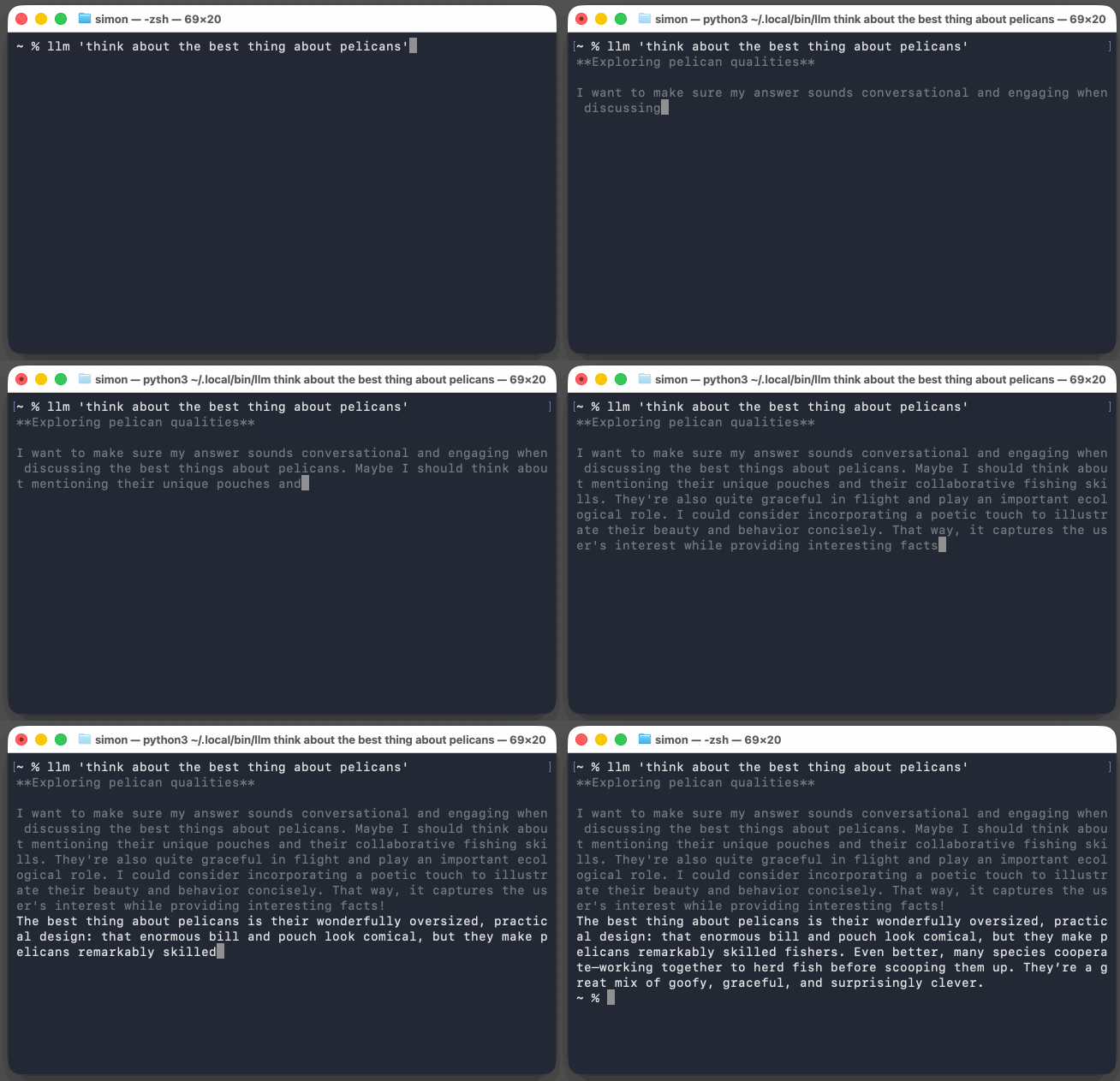
The latest release, LLM 0.32, introduces significant advancements to the LLM project, marking its most substantial update since its initial launch. Key new features include visible reasoning traces for AI models, allowing users to understand their decision-making process by displaying "thinking" steps to standard error. The update also brings support for server-side provider tools, such as OpenAI's Code Interpreter and WebSearch, enabling LLM to execute prompts that leverage these external capabilities. A redesigned content-addressable SQLite logging system, inspired by Git, offers more efficient and structured storage of conversation histories. New models, including the GPT-5.6 family with GPT-5.6 Luna as the new default, are now supported. The LLM Python API has been revamped, moving from a one-message-at-a-time approach to a more flexible `model.prompt(messages=[])` parameter that handles complete conversation histories. Furthermore, the streaming events system now accommodates diverse model outputs, including text, reasoning, tool calls, and attachments, moving beyond simple string responses. This enables a robust implementation of the OpenAI chat completions API via the new `llm-chat-completions-server` plugin. Plugin updates for `llm-anthropic`, `llm-gemini`, and `llm-openrouter` are also detailed, with `llm-anthropic` now supporting Claude 5 models and additional server-side tools. The project is increasingly being viewed as an agent framework, with features like tool pausing for human approval and resuming from stored history being incorporated, potentially leading to a more integrated "agent" concept in future releases.
The LLM 0.32 release signifies a maturation of large language model interfaces, shifting from basic text generation to more complex, observable, and tool-integrated workflows. The introduction of reasoning traces and a more robust event streaming system addresses the "black box" nature of AI, providing users with greater transparency into model operations. This enhanced visibility is crucial for debugging, fine-tuning, and building trust in AI systems. The integration of server-side tools and the move towards an agent-like framework suggest a future where LLMs act as orchestrators of various computational resources, rather than standalone entities. This evolution aligns with broader trends in AI development, where the focus is on creating intelligent systems that can interact with and manipulate their environment through defined interfaces, potentially leading to more autonomous and capable AI applications in the coming decade.
AI-generated to prompt reflection — not editorial opinion, not advice, not a statement of fact. How this works.
