Luis Galarreta: Peru's Vice President-Elect, Who Uses Hook Prosthetics
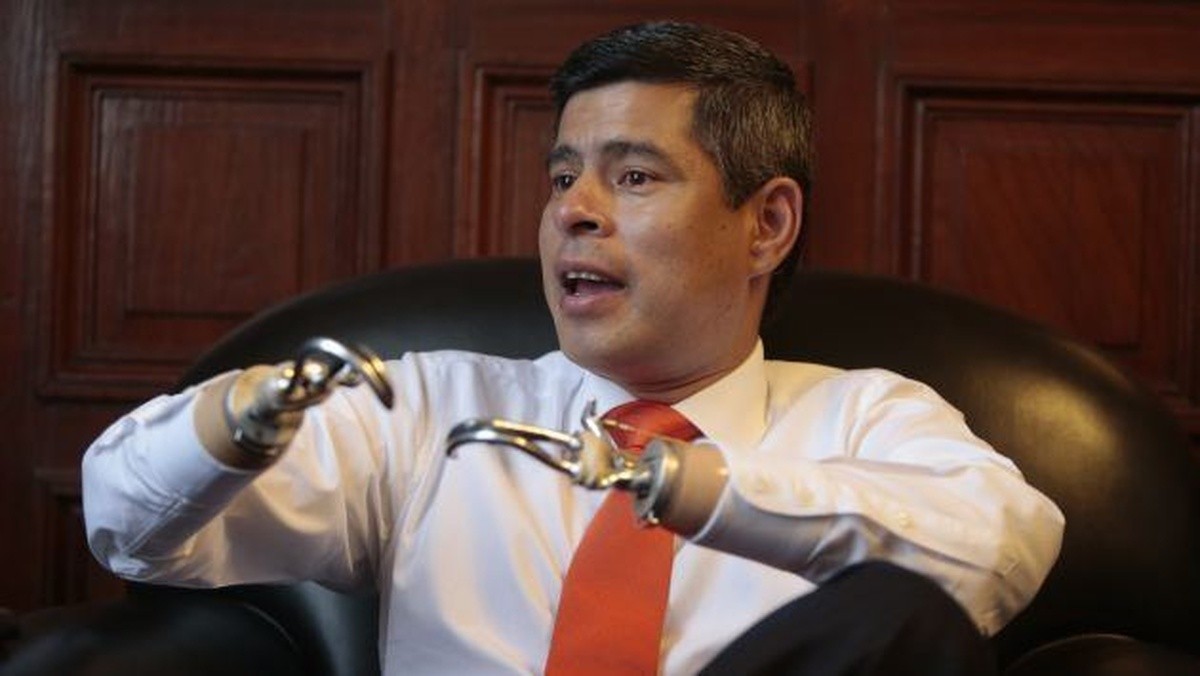
Luis Galarreta, Keiko Fujimori's running mate, has gained significant attention during Peru's electoral campaign due to his use of hook-shaped prosthetics in place of hands. Galarreta is set to become the Vice President of Peru. Born in Lima in 1971, Galarreta was born with a congenital malformation of his upper limbs. At just three months old, doctors recommended the amputation of his arms, a decision influenced by medication his mother took during pregnancy that affected fetal development. Galarreta stated that his mother and father were informed of a potential malformation before his birth and that amputation was medically advised, acknowledging it must have been a difficult choice. He expressed that his life story is rich and he wouldn't change anything.
Before aligning with Fujimori's political movement, Galarreta began his political career with the Movement for Liberty, led by Mario Vargas Llosa. He first ran for Congress in 2001 but was unsuccessful. In 2002, he was elected a councilman in Lima, followed by his first term as a deputy in 2006, and re-election in 2011. During this period, he was part of the center-right Christian People's Party (PPC), maintaining a distance from Keiko Fujimori's movement. His relationship with Fujimorismo was not always amicable; in 2011, he strongly criticized the government of Keiko's father, former President Alberto Fujimori, citing institutional problems, human rights violations, and corruption in the 1990s.
After leaving the PPC for personal reasons, Galarreta joined Fuerza Popular, Keiko Fujimori's party, in 2015, marking a significant political shift and establishing him as a key ally. He served as the party's spokesperson during the 2016 presidential campaign and became president of the Peruvian Congress in 2017. He subsequently began publicly defending the legacy of the 1990s, acknowledging errors and crimes during Alberto Fujimori's presidency but also highlighting positive outcomes in other areas. Currently, in addition to being on Keiko Fujimori's presidential ticket, Galarreta serves as vice president of the Andean Parliament.
Luis Galarreta's ascent to the vice presidency highlights the complex interplay of personal narrative and political strategy in Peruvian politics. His unique personal circumstances, while a source of public attention, frame a political journey marked by ideological shifts and strategic alliances. His past criticisms of the Fujimori legacy, contrasted with his later embrace of it, suggest a pragmatic approach to political advancement, prioritizing coalition building and electoral success over strict ideological consistency. This dynamic raises questions about the durability of political platforms when faced with the imperative of gaining power, particularly in a landscape where historical grievances and future aspirations often converge. The long-term implications for governance may depend on how Galarreta and Fujimori navigate the inherent tensions between their past critiques and present commitments, and whether their coalition can foster stable policy development or is primarily a vehicle for electoral victory.
AI-generated to prompt reflection — not editorial opinion, not advice, not a statement of fact. How this works.