Madrid's Near-Magic Square Echoes Gaudí's Sagrada Familia
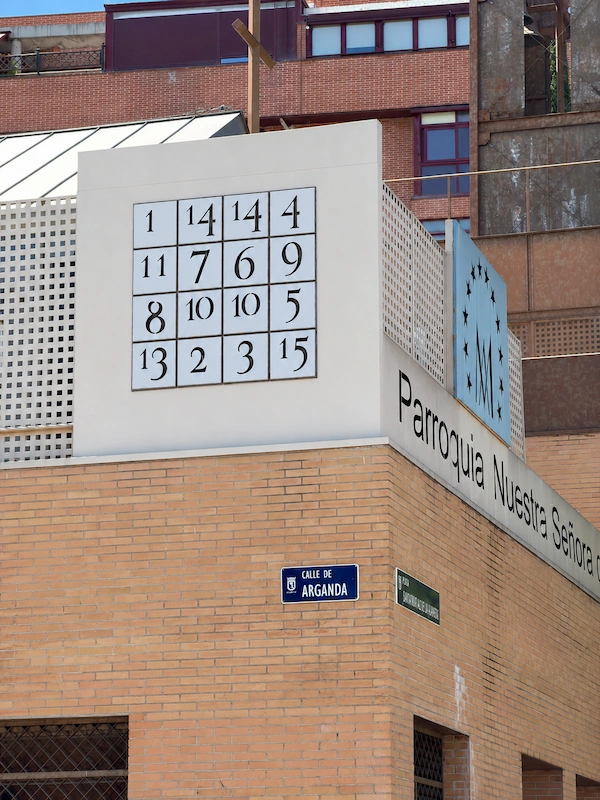
A visitor in Madrid discovered a 'nearly magic' square with a constant sum of 33, mirroring the one found on the Passion Facade of Antoni Gaudí's Sagrada Familia in Barcelona. This square, located in the Acacias neighborhood in southern Madrid, features rows, columns, and main diagonals that all add up to 33, a number famously associated with the age of Christ. However, it deviates from being a true magic square because it contains repeated numbers (10 and 14) and is missing others (12 and 16). The Acacias area is noted for its mathematical and geometric art, with several plazas hosting sculptures. The visitor also explored nearby plazas featuring sculptures of the Platonic solids, part of what is known as the Platonic Solids route. This route is also referred to by other descriptive names, including the initiatory path of the green corridor and 'Masonic Madrid,' highlighting the area's strong connection to mathematical and geometric themes.
This discovery highlights how mathematical concepts, like magic squares, can transcend their original contexts and appear in diverse urban environments, potentially serving as subtle cultural markers. The comparison to Gaudí's work suggests an intentional or coincidental resonance with symbolic numerical systems. The presence of multiple mathematical and geometric sculptures in the Acacias neighborhood indicates a deliberate artistic or urban planning initiative aimed at integrating abstract concepts into public space. Such initiatives can foster public engagement with STEM fields by making them visually accessible and aesthetically pleasing, potentially influencing future urban design trends that prioritize intellectual and artistic integration.
AI-generated to prompt reflection — not editorial opinion, not advice, not a statement of fact. How this works.