Madridoku: New Daily Puzzle Game Turns Madrid Metro into an Engaging Challenge
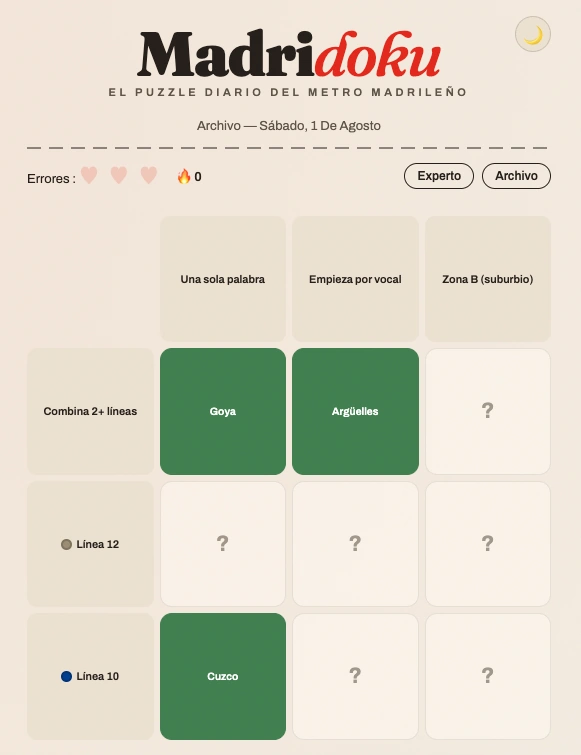
A new daily puzzle game called Madridoku challenges players to identify nine Madrid Metro stations within a 3x3 grid, similar to Sudoku. Players are presented with clues related to metro lines, stations, and zones, with each station usable only once. The game offers a maximum of three attempts per puzzle, and all participants receive the same daily challenge. An "Expert" mode requires players to recall station names from memory, and an archive allows access to previous days' puzzles, though these do not count towards streaks. The game is the creation of independent developer Julián, operating under Jema Games, who has adapted a successful concept from other cities. Similar games like Métrodoku in Paris, which boasts over 30,000 regular players, and Tubedoku in London, have achieved significant popularity. Madridoku follows the same principles as its predecessors, being free to play, ad-free, and requiring no account creation. The game appeals to those with a deep familiarity with the Madrid Metro system, including locals and enthusiasts of public transportation.
Madridoku leverages the ingrained knowledge and daily routines of urban commuters, transforming a familiar public transit system into an accessible digital game. By gamifying the complex network of the Madrid Metro, the developer taps into established user familiarity and a desire for low-stakes cognitive challenges. This approach mirrors successful models in other major cities, indicating a potentially scalable market for transit-themed puzzles. The game's free, ad-free, and account-free model lowers barriers to entry, encouraging widespread adoption and daily engagement, which are key metrics for sustained user retention in the casual gaming sector. Future iterations could explore integration with real-time transit data or personalized challenges based on a user's typical commute.
AI-generated to prompt reflection — not editorial opinion, not advice, not a statement of fact. How this works.