Magnetic Properties of Low-Energy Enhancement in 70Zn
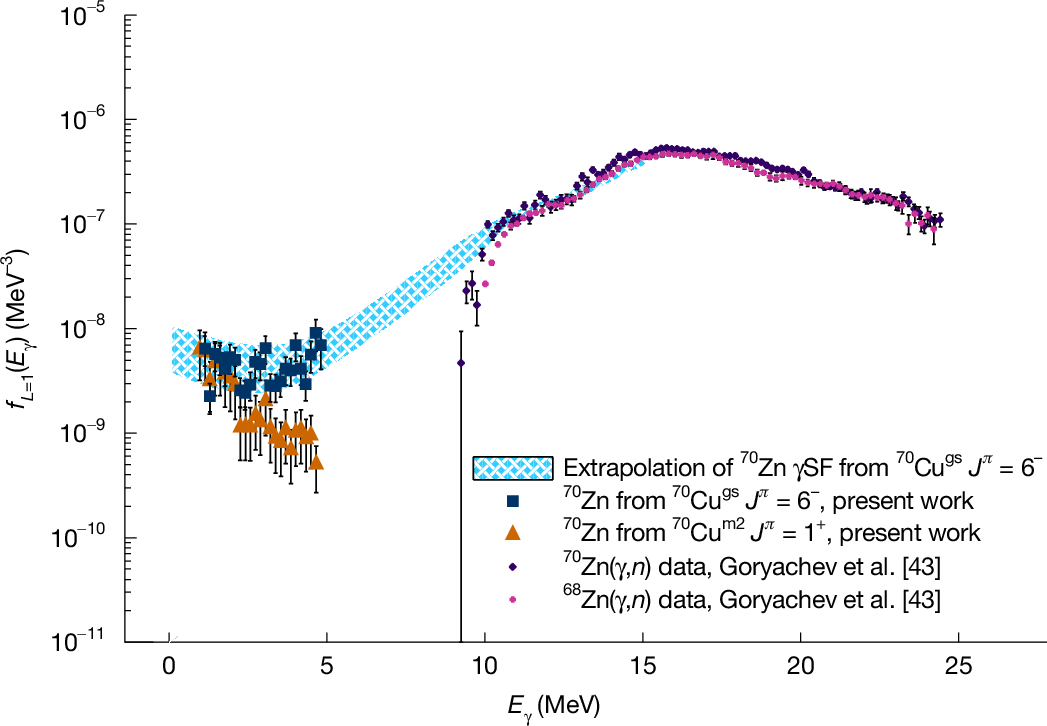
This research investigates the magnetic character of a low-energy enhancement observed in the isotope 70Zn. The study focuses on understanding the underlying nuclear structure and interactions that lead to this specific magnetic behavior. By analyzing experimental data, scientists aim to shed light on the fundamental forces governing atomic nuclei. The findings contribute to the broader field of nuclear physics, particularly in the study of exotic nuclei and their properties. Understanding these enhancements is crucial for developing more accurate theoretical models of nuclear matter. The research explores how nucleons arrange themselves within the nucleus to produce observable magnetic effects. This detailed examination of 70Zn provides a case study for similar phenomena in other isotopes. The ultimate goal is to advance our comprehension of nuclear forces and the stability of matter.
This study delves into the fundamental magnetic properties of the 70Zn isotope at low energies. Understanding such nuclear characteristics is essential for refining theoretical models of nuclear structure and interactions. The research contributes to the broader scientific quest to map the behavior of atomic nuclei, which underpins fields ranging from astrophysics to materials science. By precisely characterizing these magnetic enhancements, scientists can better predict the properties of other isotopes and potentially discover new nuclear phenomena. This work highlights the ongoing effort to decode the complex forces that bind atomic nuclei, offering insights into the fundamental building blocks of matter and their energetic states.
AI-generated to prompt reflection — not editorial opinion, not advice, not a statement of fact. How this works.