Magnitude 7.1 Earthquake Strikes Japan's Kyushu Region, Causing Damage and Injuries
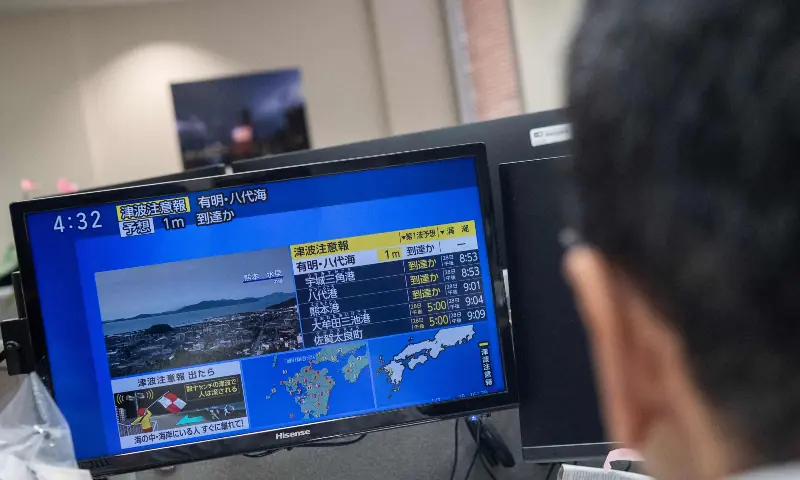
A powerful magnitude 7.1 earthquake struck Japan's southern Kumamoto prefecture on Kyushu island on Tuesday, resulting in widespread power outages affecting approximately 40,000 homes and halting railway services, including bullet trains. The tremor triggered tsunami and aftershock warnings for several prefectures, including Kumamoto, Nagasaki, Kagoshima, Fukuoka, Saga, Oita, and Miyazaki. While a one-meter tsunami was initially warned, the Japan Meteorological Agency reported no observed tsunami activity and anticipated lifting the advisory. Prime Minister Sanae Takaichi confirmed reports of several injuries, collapsed buildings, fires, and damage to infrastructure such as roads and bridges. Companies with facilities in the affected area, including Sony and TSMC, were assessing the situation. No irregularities were reported at local nuclear power stations. Japan, situated on the Pacific "Ring of Fire," experiences frequent seismic activity, accounting for about 20% of global earthquakes of magnitude 6.0 or higher. A significant earthquake in Kumamoto a decade ago resulted in 275 fatalities and over 2,700 injuries.
This seismic event underscores Japan's persistent vulnerability to earthquakes due to its geological location. While emergency response systems appear to have functioned, the scale of disruption to infrastructure and residential power highlights the ongoing challenge of building resilience against natural disasters. The presence of critical industries like semiconductor manufacturing in earthquake-prone zones raises questions about supply chain risk mitigation and the long-term strategic implications of locating such facilities. Future planning will likely need to integrate advanced seismic monitoring, reinforced infrastructure standards, and robust business continuity protocols to minimize societal and economic impact in an era of increasing global interdependence and technological reliance.
AI-generated to prompt reflection — not editorial opinion, not advice, not a statement of fact. How this works.