Mars' Atmosphere Reacts to Solar Storms Differently During Dust Storms, Study Finds
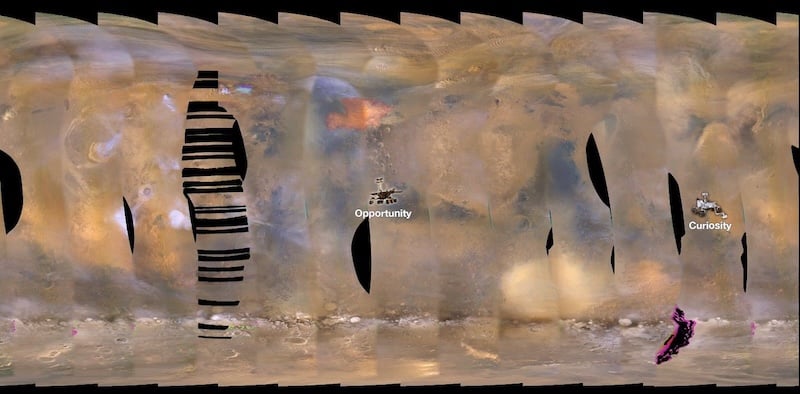
A recent study presented at the Royal Astronomical Society's National Astronomy Meeting has uncovered a surprising interaction between solar storms and the Martian atmosphere. Researchers found that solar storms may warm the lower atmosphere of Mars, but this effect is contingent on the planet simultaneously experiencing a major dust storm. This discovery was serendipitous, arising from an investigation into an unrelated phenomenon. The findings suggest that the atmospheric and weather systems on Mars are more complex and interconnected than previously understood by the scientific community. This implies that future models of Martian climate and atmospheric dynamics will need to account for these newly identified interactions. The study highlights the potential for unexpected discoveries when exploring planetary environments. Further research is needed to fully understand the mechanisms behind this interaction and its broader implications for Mars' climate.
This finding challenges previous assumptions about the Martian atmosphere's relative simplicity. It suggests that complex feedback loops, similar to those observed on Earth, may be at play on Mars. The interaction between solar activity and dust storms indicates that atmospheric models need to incorporate more variables, potentially revealing new insights into Mars' climate history and habitability. Understanding these interconnected systems is crucial for future missions, as it may influence atmospheric conditions relevant to landing, surface operations, and the search for past or present life.
AI-generated to prompt reflection — not editorial opinion, not advice, not a statement of fact. How this works.