Massive Matter Ejected from Galaxies May Explain Universe's Missing Material
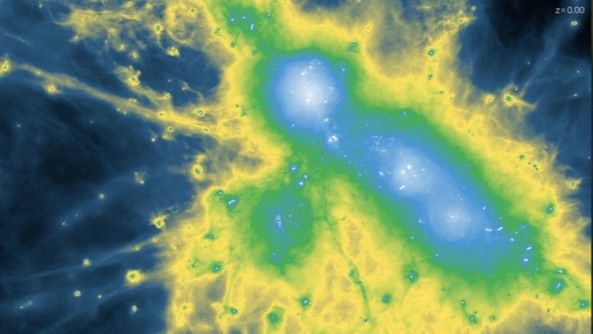
Scientists believe they may have located a significant portion of the universe's missing ordinary matter, which has been powerfully ejected from galaxies. The total amount of ordinary matter observed in the universe is approximately one-tenth of what cosmological models predict. This discovery suggests that this "missing" matter might reside in the vast intergalactic spaces, having been expelled from galactic structures. The ejection process appears to have been more violent than initially anticipated by researchers. This finding could help resolve a long-standing discrepancy in our understanding of the universe's composition. Further research is expected to confirm the extent and nature of this intergalactic matter. The implications of this discovery are significant for cosmology and our models of cosmic evolution. Understanding the distribution of all matter is crucial for refining theories about the universe's formation and development.
This finding addresses a significant gap in cosmological models, suggesting that the universe's ordinary matter may be more diffusely distributed than previously assumed. The powerful ejection mechanism highlights the dynamic processes occurring within galactic systems and their impact on the broader cosmic environment. Understanding these large-scale matter flows is crucial for refining simulations of cosmic structure formation and evolution. Future research will likely focus on the efficiency of these ejection processes and the long-term stability of this intergalactic matter, potentially influencing our understanding of dark matter and dark energy interactions over the next decade.
AI-generated to prompt reflection — not editorial opinion, not advice, not a statement of fact. How this works.