Masudur Rahman's "Antore Ontorikkhe" Exhibition Bridges the Mundane and the Cosmic
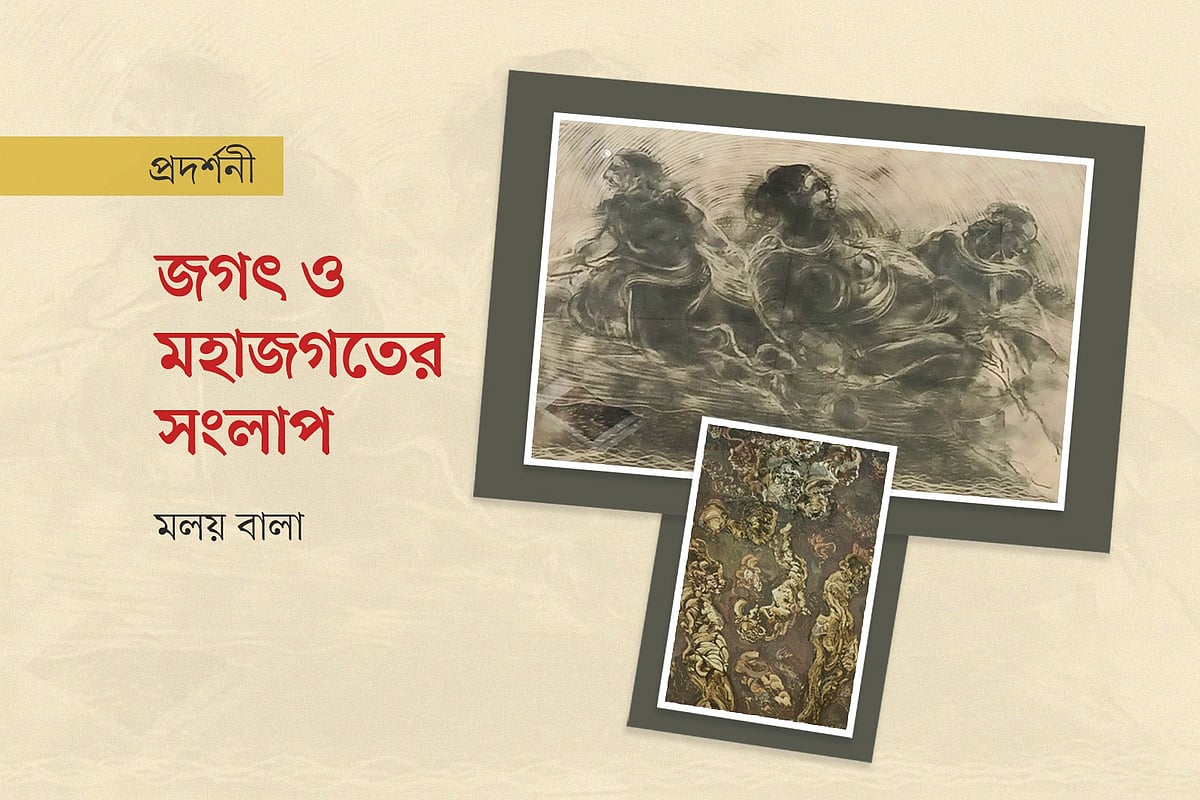
The exhibition "Antore Ontorikkhe" by artist Masudur Rahman, held at the Safiuddin Art Gallery in Dhaka, pays tribute to the 104th birth anniversary of art maestro Safiuddin Ahmed. The exhibition, which began on June 26 and runs until July 5, explores the profound connection between the human experience and the vastness of the universe. Rahman's signature style is characterized by a dual interpretation of his works; from afar, they appear as landscapes or abstract forms, but upon closer inspection, human figures and forms emerge. This interplay between the visible and the invisible, the body and nature, humanity and the cosmos is a hallmark of his artistic language. The titles of his pieces, such as 'Anchor of Memory,' 'Archaeology of Memory,' and 'Map of Inner Currents,' serve as gateways to the viewer's emotional landscape, touching upon themes of memory, love, rebellion, pain, rebirth, and the desire for freedom. Rahman, a former student of Dhaka University's Department of Oriental Art, employs a unique technique, mixing oil paints and charcoal and applying them with his palms, fingers, and nails instead of brushes. This tactile process creates an organic texture on the canvas, reminiscent of cloud layers, eroded stone, or human skin, which forms the lifeblood of his art. His figures often serve as symbols of life floating in space, or as vessels of memory and mutual support, reflecting a cosmic philosophy deeply rooted in his Eastern artistic sensibilities. The recurring motif of the human body and existence, particularly in relation to water and clouds in pieces like 'Unceasing Stream' and 'Clouds of Memory,' illustrates a cyclical interplay between water, clouds, and the body. Rahman's color palette, featuring deep blues, grays, earthy tones, hints of crimson, and faint golden light, evokes deep emotion and a sense of mysterious cosmic space. His artistic vision is profoundly influenced by the cosmic philosophy of Shiva, viewing Shiva's Tandava not just as a mythological reference but as an eternal metaphor for the endless cosmic cycle of creation, preservation, destruction, and rebirth. This perspective inspires him to explore existence, time, and the inner transformations of the human mind. His deep affection for rivers also forms a fundamental basis for his artistic identity, with the river's vastness and continuous flow symbolizing a spiritual experience that bridges the soul and body, the visible and the invisible. The exhibition ultimately presents itself as an artistic journey from the finite human life to the infinite universe, where earthly reality and cosmic feeling are not opposing forces but complementary elements, creating a creative bridge between the mundane and the cosmic.
This exhibition offers a compelling exploration of the human condition through the lens of cosmic philosophy and natural imagery. Masudur Rahman's artistic approach, blending abstract textures with emergent figuration, challenges conventional interpretations and invites viewers to engage with multiple layers of meaning. The artist's synthesis of Eastern philosophical concepts, particularly Shiva's cosmic dance, with the universal symbolism of rivers, suggests a profound understanding of cyclical processes in both nature and human consciousness. This perspective can be viewed as a response to the increasing fragmentation of modern life, offering a holistic framework that connects individual existence to larger universal patterns. The tactile application of paint, eschewing traditional tools, further emphasizes a direct, almost primal connection to the creative process, potentially resonating with a growing societal interest in mindfulness and authentic expression in the digital age. The exhibition's success lies in its ability to foster a sense of interconnectedness, prompting reflection on our place within the vastness of existence, rather than dictating a singular conclusion.
AI-generated to prompt reflection — not editorial opinion, not advice, not a statement of fact. How this works.