Metamaterials' Fracture Resistance Programmed Using Elastic Instabilities
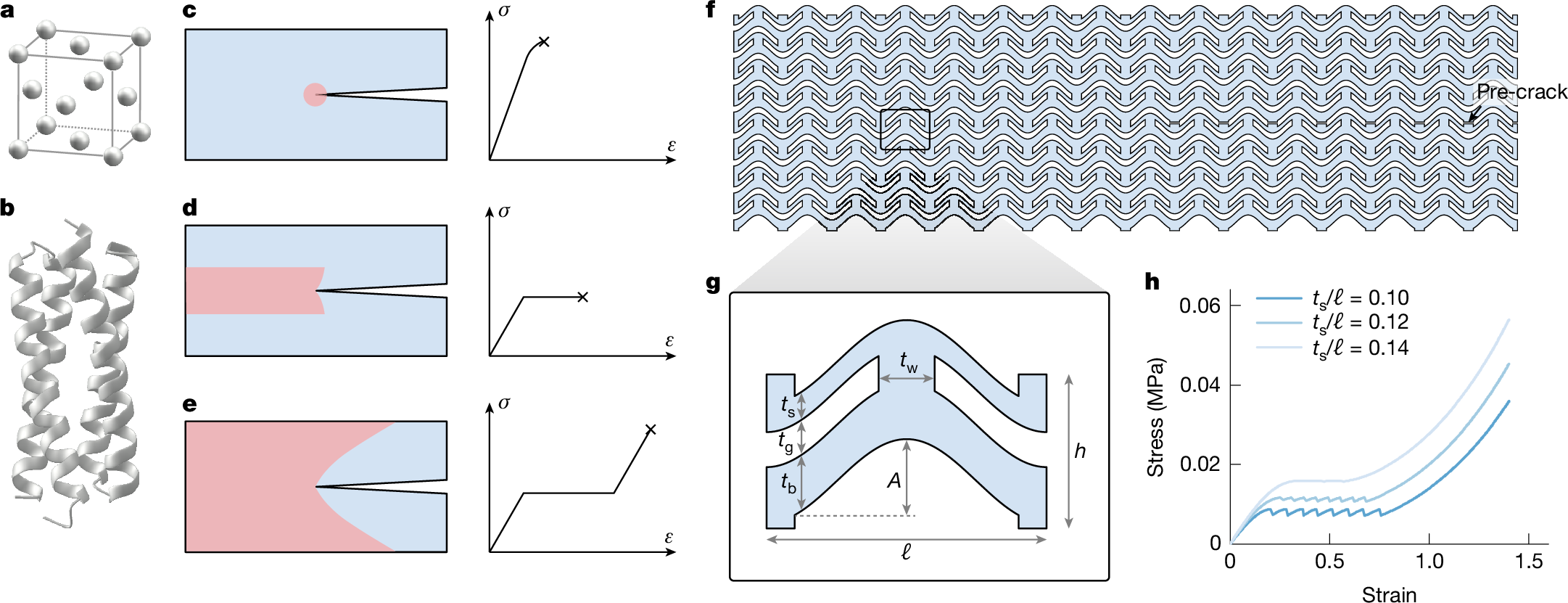
Researchers have developed a novel method to program fracture resistance in metamaterials by leveraging elastic instabilities. This breakthrough allows for the controlled manipulation of how these advanced materials respond to stress and potential damage. Metamaterials, engineered at the micro or nanoscale, possess properties not found in naturally occurring materials, making them suitable for a wide range of applications.
The technique involves designing metamaterials with specific geometric configurations that, when subjected to external forces, undergo predictable elastic instabilities. These instabilities can redirect stress, absorb energy, or even initiate localized deformation in a way that prevents catastrophic fracture. This controlled failure mechanism offers a new paradigm for designing materials with enhanced durability and resilience.
The ability to program fracture resistance opens up possibilities for creating safer and more robust structures, from aerospace components to protective gear. Future research may focus on scaling this technique for industrial applications and exploring its potential in other material systems.
This research introduces a novel approach to material design by integrating mechanical instability into the fundamental properties of metamaterials. By engineering predictable failure modes, the scientists aim to enhance material resilience, moving beyond traditional strength-based design. This concept could significantly impact fields requiring high durability, such as aerospace and defense, by offering materials that fail gracefully rather than catastrophically. The long-term implication lies in developing adaptive structures that can self-regulate their response to stress, aligning with the growing demand for intelligent and sustainable materials in the coming decade.
AI-generated to prompt reflection — not editorial opinion, not advice, not a statement of fact. How this works.