Milky Way Galaxy May Have Flipped 90 Degrees in Ancient Collision
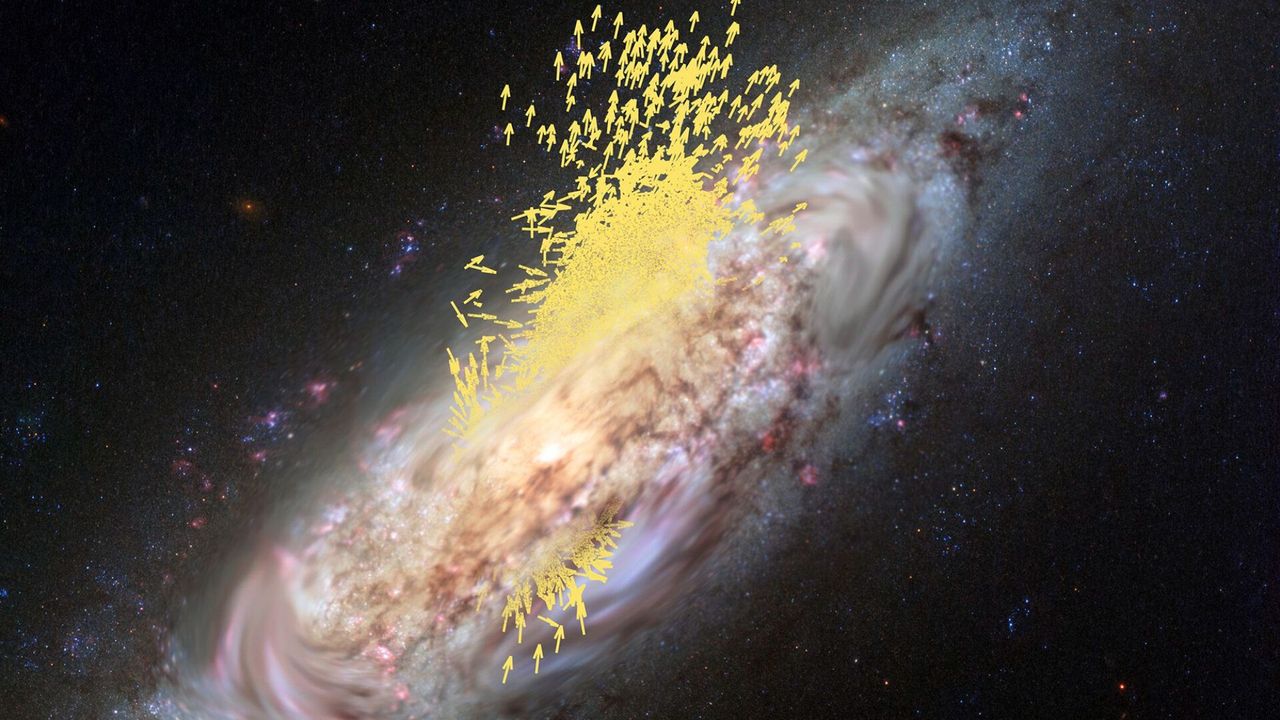
Astronomers have uncovered evidence suggesting that our Milky Way galaxy may have undergone a dramatic 90-degree flip in orientation billions of years ago. This significant reorientation is believed to have been caused by a colossal collision with a dwarf galaxy known as Gaia-Sausage-Enceladus. The impact of this ancient merger is thought to have reshaped the Milky Way's structure and stellar populations. Researchers analyzed data from the European Space Agency's Gaia mission, which maps the positions and movements of stars with unprecedented precision. The study focused on the distribution and motion of stars within the Milky Way's halo, a diffuse region surrounding the galactic disk. Observations revealed a distinct pattern of stellar motion that is inconsistent with a stable, undisturbed galaxy. Instead, the data strongly indicates a violent past event that fundamentally altered the galaxy's spin axis. The Gaia-Sausage-Enceladus dwarf galaxy, which is now largely absorbed into the Milky Way, is the prime suspect for this cosmic upheaval. Its merger with our galaxy likely imparted a massive angular momentum, forcing the Milky Way to reorient itself. This discovery provides crucial insights into the turbulent history of galactic evolution and the processes that shape galaxies over cosmic timescales.
The proposed 90-degree flip of the Milky Way galaxy, attributed to a merger with the Gaia-Sausage-Enceladus dwarf galaxy, highlights the dynamic and often violent nature of galactic evolution. This event underscores that large-scale structures are not static but are subject to significant transformations through gravitational interactions and mergers. Understanding such past events is critical for refining models of galaxy formation and evolution, particularly in the context of the ongoing AI-driven analysis of vast astronomical datasets. The study's reliance on precise stellar motion data from missions like Gaia demonstrates the power of observational astronomy in reconstructing cosmic history. Future research will likely focus on correlating this event with other observed galactic features and refining the timeline of the merger to better understand its long-term impact on the Milky Way's structure and the potential for future significant reorientations.
AI-generated to prompt reflection — not editorial opinion, not advice, not a statement of fact. How this works.