Milky Way's outer arms extend 10% further than previously estimated
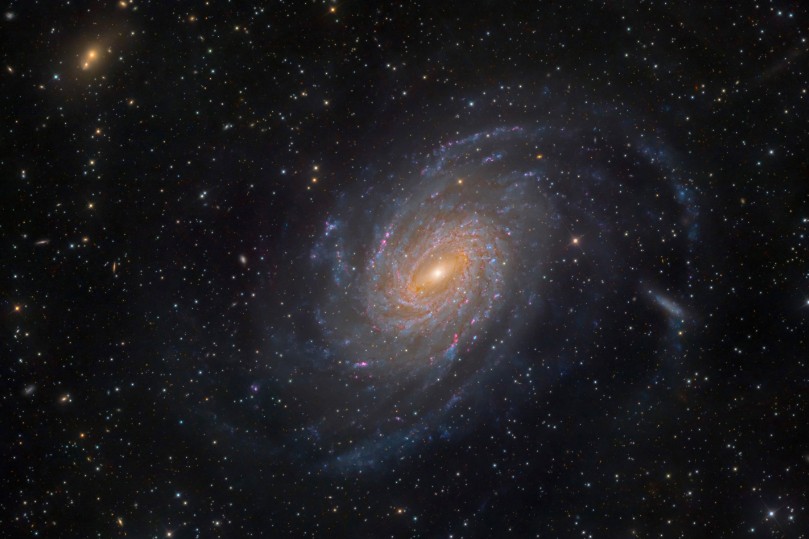
Astronomers have discovered that the outer spiral arms of the Milky Way galaxy extend approximately 10% further than previously believed. This new estimate was derived by precisely measuring the distances to dust clouds located in these outer arms. The researchers utilized data from NASA's Chandra X-ray observatory and the European Space Agency's XMM-Newton observatory to analyze X-ray echoes. These echoes originated from powerful extragalactic events, such as gamma-ray bursts (GRBs), and reflected off dust clouds within the galaxy. By observing the ring-like structure of these X-ray echoes, astronomers could determine distances to specific dust clouds and, consequently, the extent of the spiral arms. Specifically, three GRBs—GRB 031203, GRB 160623A, and GRB 221009A—were analyzed to measure distances to the Perseus arm, an outer arm, and the Scutum-Centaurus arm. The study found that the outer arm and the Scutum-Centaurus arm are about 10% more distant from the galactic center than prior estimates suggested. This geometric method offers a more precise measurement than previous techniques, which often relied on assumptions about the galaxy's rotation. While this X-ray echo technique is highly effective, its application is limited by the rarity of intense GRBs visible through the galactic plane. Future research, including data from the Gaia mission and the ESA's upcoming NewAthena X-ray observatory, is expected to further refine our understanding of the Milky Way's structure.
This research refines our understanding of the Milky Way's scale by employing a novel X-ray echo technique, offering a more precise measurement of its outer spiral arms' extent. While the method's reliance on rare extragalactic events limits its routine application, it highlights the ongoing evolution of astronomical measurement capabilities. The findings underscore the dynamic nature of galactic structures and the importance of cross-referencing data from multiple observatories, such as Gaia and Chandra. As technology advances, particularly with next-generation instruments like NewAthena, astronomers will continue to refine our cosmic address, potentially revealing further complexities in galactic morphology and evolution over the next decade.
AI-generated to prompt reflection — not editorial opinion, not advice, not a statement of fact. How this works.