Moonshot AI's K3 Report Introduces Novel Architectures, Challenging DeepSeek's Frontier
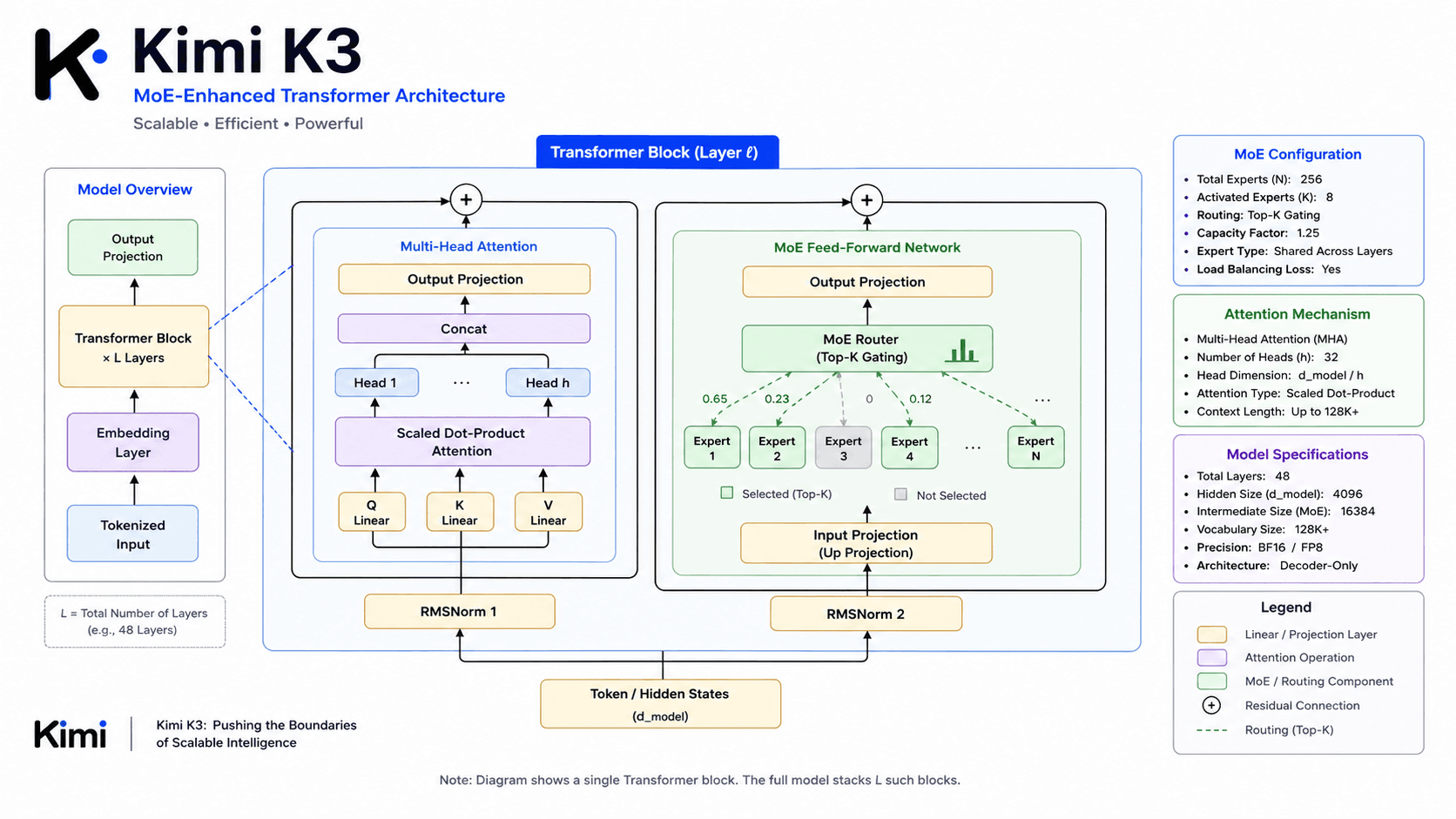
Moonshot AI has released a 47-page technical report detailing their K3 model, which introduces several innovative architectural components. The report highlights a hybrid attention mechanism combining KDA (Kernel-based Dynamic Attention) and Gated MLA (Multi-Layered Attention). It also features AttnRes, a cross-layer retrieval system designed to enhance information flow within the model. Furthermore, the K3 model incorporates Stable Latent Mixture-of-Experts (MoE) with a significant number of 896 experts. The report also mentions the use of 51.2 million Reinforcement Learning (RL) sandboxes, suggesting a large-scale training or evaluation environment. These advancements position Moonshot AI as a significant contender in the AI development landscape, potentially setting new benchmarks and posing challenges to existing leading models like those from DeepSeek.
The K3 report from Moonshot AI introduces architectural innovations like KDA+Gated MLA hybrid attention and Stable LatentMoE, signaling a strategic push to advance large language model capabilities. By integrating novel components such as AttnRes cross-layer retrieval and leveraging extensive RL sandboxes, Moonshot AI appears to be exploring new scaling axes beyond traditional parameter count. This focus on architectural efficiency and novel training methodologies could redefine competitive dynamics in the AI sector, prompting a re-evaluation of current frontier models and development strategies. The emphasis on hybrid attention and MoE architectures suggests a move towards more efficient and potentially more capable models, which aligns with the broader industry trend of seeking performance gains through architectural innovation rather than solely through brute-force scaling.
AI-generated to prompt reflection — not editorial opinion, not advice, not a statement of fact. How this works.