Motion Brain Secures Nearly $14 Million in Additional Pre-A Funding
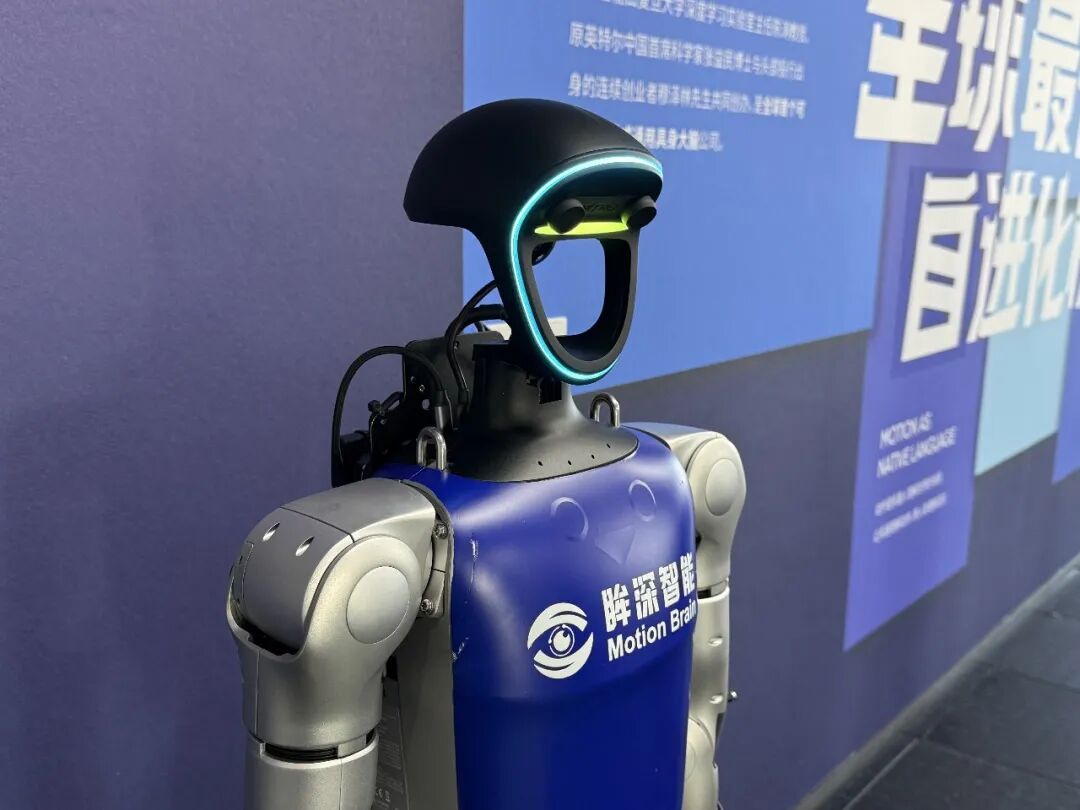
Motion Brain, a company specializing in embodied AI brains for robots, has successfully closed an additional Pre-A funding round, raising nearly 100 million yuan (approximately $14 million USD). This investment was led by a consortium of prominent investors including a leading Chinese property management firm, a Hong Kong consortium, and an industrial investment platform called Jinyue Investment, alongside existing shareholder Xuhui Capital. This funding follows a previous 300 million yuan Pre-A round in May 2026 and comes as Motion Brain is finalizing another nearly 500 million yuan Pre-A+ round. The company reports its valuation has surged over tenfold in the first half of 2026, positioning it as one of the fastest-growing embodied AI companies in the industry. Founded in January 2025 by Professor Chen Tao from Fudan University, former Intel Chief Scientist Dr. Zhang Yimin, and serial entrepreneur Mu Zelin, Motion Brain aims to equip one billion robots with a native, general-purpose brain. The core team boasts experience from major chip manufacturers like HiSilicon, Intel, and Nvidia, and possesses rare capabilities in operator-level adaptation for large embodied models. Motion Brain's technological foundation, which began in 2022, diverges from mainstream Vision-Language-Action (VLA) models by focusing on a "World Motion Model" centered on action. Their MLD (Latent Space Motion Diffusion Model), introduced in 2022, was a pioneering approach that mapped actions into a latent space and utilized diffusion models, enabling AI to generate natural and coherent human poses without explicit frame-by-frame instruction. Building on this, MotionGPT, released in September 2023, tokenized human poses into approximately 3,000 "action tokens," allowing complex behaviors to be generated by predicting the next action token, akin to how large language models generate sentences. This method significantly enhances understanding of long-sequence tasks and enables zero-shot generalization for unseen action commands. The company has iterated through seven model generations, culminating in the STI-WM (Spacetime-Integrated World Motion Model), designed for long-term planning, online closed-loop control, and physical interaction in robots. STI-WM notably reduces reliance on real-world robot data by training on 80% internet videos, 10% motion capture data, and 10% real robot data, achieving 99% action accuracy while decreasing real-world data requirements by 90%. Furthermore, their T²MB (Task*Task Motion Brain) model, proposed in March 2026, allows for offline self-evolution on edge devices, improving task execution accuracy by up to 25% through local interaction without needing to upload data. Nvidia's ARDY model has referenced Motion Brain's MLD and MotionGPT technologies, marking the fourth instance of Nvidia's third-generation motion models citing their work. A key competitive advantage for Motion Brain lies in edge computing cost reduction through model compression and adaptation to domestic chips. They have compressed billion-parameter models to tens of billions, reducing inference latency from 200ms to 10ms, and have successfully adapted their models to domestic chip platforms like HiSilicon (Ascend 310/910), Horizon Robotics, and Moore Threads (S60). This soft-hard synergy has reduced end-side inference costs from 200,000 yuan to 10,000 yuan, increased battery life tenfold, and maintained accuracy. This optimization work also earned the team the IJCAI 2025 Best Paper Award, the only Chinese mainland team to receive this honor in five years. Motion Brain can adapt its embodied AI models to different robot bodies within two weeks. CEO Mu Zelin emphasizes their commitment to native development on domestic computing chips for the entire process of model training and inference, ensuring technological self-reliance, unlike many domestic companies that train on foreign chips and then adapt. Commercially, Motion Brain is one of the few domestic embodied AI companies generating revenue, with audited revenue of tens of millions of yuan in 2025 and 30 million yuan in the first half of 2026, projecting over 50 million yuan in revenue for 2026. Their clients span industrial inspection, property management, and sanitation, with ongoing projects involving humanoid robots for retail and home appliance manufacturing.
Motion Brain's substantial funding and rapid valuation growth highlight the intense global race to develop foundational embodied AI. Their strategic focus on a "World Motion Model" and the innovative "action tokenization" approach, coupled with significant advancements in data efficiency and edge deployment, addresses critical bottlenecks in robot scalability. The company's proactive adaptation to domestic chip architectures, rather than solely relying on established foreign suppliers, positions them to navigate potential supply chain risks and capitalize on national technological self-sufficiency initiatives. This dual emphasis on algorithmic innovation and hardware-software co-optimization, particularly for edge computing, is crucial for enabling widespread, cost-effective deployment of intelligent robots across diverse industries. The long-term challenge will be maintaining this pace of innovation against well-funded global competitors and ensuring their "native general-purpose brain" can adapt to the exponentially increasing complexity of real-world robotic tasks and sensor inputs in the coming decade.
AI-generated to prompt reflection — not editorial opinion, not advice, not a statement of fact. How this works.