MP Questions if BNP Aims for One-Party Rule Through Reserved Seat Allocations
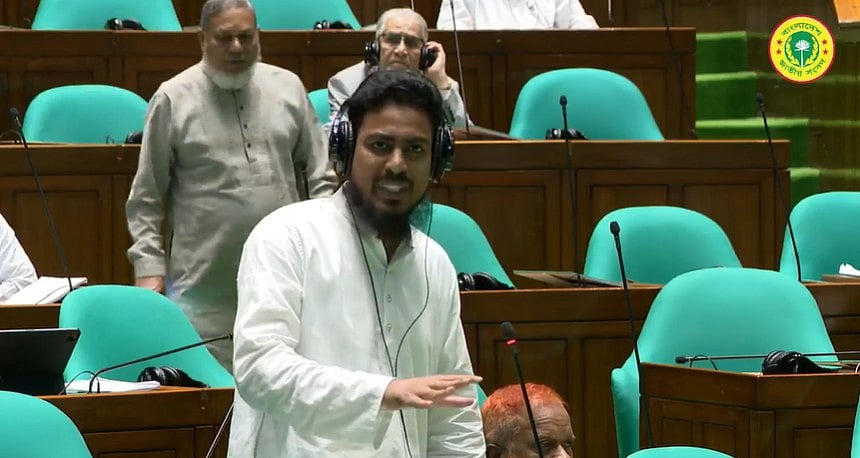
National Citizen Party (NCP) Secretary-General Akhtar Hossain raised a significant question in Bangladesh's Parliament, inquiring whether the Bangladesh Nationalist Party (BNP) is attempting to establish a one-party system. Hossain's concern stems from what he perceives as the 'additional' responsibilities assigned to government-affiliated women members in constituencies traditionally held by the opposition. He voiced this concern during a point of order on Monday, noting his own active participation in a July movement against the ruling party's alleged one-party rule. Hossain's query was prompted by a statement from Jiba Amina Khan, a BNP member of Parliament for a reserved women's seat, who mentioned visiting Pirganj and Mithapukur for 'additional responsibilities.' Hossain, whose own constituency includes Pirgacha Upazila, stated that he had heard from BNP activists that the reserved seat MP, not the elected one, was considered the de facto representative for those areas, with all matters needing to go through her. This contradicts an earlier statement by Local Government State Minister Mir Shahe Alam, who denied any such additional responsibilities were assigned. The NCP leader sought clarification on the truth of these claims, the scope of these responsibilities, their execution, and their constitutional validity. He specifically highlighted that these 'additional responsibilities' were seemingly allocated only to opposition-held seats, raising fears of a deliberate strategy by the BNP to consolidate power. In response, Home Minister Salahuddin Ahmed explained that reserved seat MPs have no specific regional constituencies and can exercise their parliamentary duties nationwide. He affirmed that these members are full MPs and can allocate resources from ministries and government agencies anywhere in Bangladesh. Ahmed commented that if a reserved seat MP designates one or two areas as 'their area,' they are voluntarily limiting their own scope of work.
The parliamentary exchange highlights a potential tension between the constitutional roles of elected and reserved seat members of Parliament, particularly concerning the allocation of responsibilities and resource distribution. The questioning of whether 'additional responsibilities' in opposition strongholds signal an intent to undermine elected representation and foster a de facto one-party structure warrants careful consideration of governance frameworks. Future parliamentary practices could benefit from clearer guidelines on the scope and oversight of responsibilities assigned to reserved seat members to ensure equitable representation and prevent potential distortions in political influence. This situation underscores the evolving dynamics of parliamentary representation in the digital age, where traditional constituency boundaries may be challenged by broader mandates and communication networks.
AI-generated to prompt reflection — not editorial opinion, not advice, not a statement of fact. How this works.