Myanmar Junta Leader Min Aung Hlaing Seeks Chinese Security Assurances
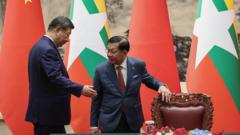
Myanmar's junta leader, Min Aung Hlaing, has visited Beijing to seek security assurances from China regarding its investments in the country. Chinese President Xi Jinping reportedly advised the Naypyidaw government to pursue a development path that aligns with the nation's conditions and garners public support, while also emphasizing the importance of development and security. The meeting underscores the junta's reliance on China amidst international isolation following the 2021 military coup. Min Aung Hlaing's visit aims to secure Chinese backing for infrastructure projects and economic initiatives, which are crucial for the regime's legitimacy and survival. China, a significant investor in Myanmar, has maintained a cautious stance, balancing its economic interests with regional stability concerns. The discussions likely covered ongoing Chinese projects and potential future collaborations, with the junta seeking to reassure Beijing about the safety of its assets and personnel.
The visit of Myanmar's junta leader to Beijing highlights the complex geopolitical dynamics at play, where economic interests and security concerns intersect. China's emphasis on a development path aligned with national conditions and public support, while seemingly constructive, can be interpreted through the lens of its own strategic objectives. The junta's pursuit of security assurances for Chinese investments reflects its precarious position and dependence on foreign support. This situation presents a systemic contradiction: the regime seeks external validation and investment for development, yet its legitimacy is undermined by internal conflict and lack of public trust. Future developments will likely hinge on China's ability to balance its economic leverage with broader regional stability and Myanmar's internal political evolution, potentially influencing governance models and the sustainability of development initiatives in the long term.
AI-generated to prompt reflection — not editorial opinion, not advice, not a statement of fact. How this works.